Enterprise iGaming Platform Development for Regulated Markets
Most operators we speak to aren’t evaluating platforms because they want to. They’re evaluating because their current platform is costing them: revenue share eating into margin, compliance changes requiring six-month vendor cycles, or a monolithic backend that makes multi-jurisdiction deployment a boardroom argument rather than an engineering sprint. This piece covers what we’ve learned building and modernizing platforms for regulated operators, the architectural decisions that actually matter, and where the industry consistently gets it wrong.








White-label platforms solve a real problem for operators entering the market. They compress time to launch. They bundle licensing support, payment integrations, and a game lobby into a single contract. For a startup operator trying to get live in Malta within six months, that trade-off makes sense.
For an established operator doing £50M+ in GGR, the calculus changes entirely.
The revenue share model that seemed reasonable at launch becomes a structural constraint at scale. We’ve seen operators paying 15-25% of net gaming revenue to white-label providers, and those percentages don’t decrease as volume grows in any meaningful way. Over a three to five year horizon, the total cost of ownership for a custom-built platform, including engineering, infrastructure, and ongoing maintenance, frequently comes in lower than the cumulative revenue share on a white-label. Not always. But more often than most operators assume before they model it properly.
Revenue share isn’t even the most expensive constraint. Roadmap dependency is. When the UKGC publishes new responsible gaming requirements with a nine-month implementation window, your ability to respond depends entirely on where that work sits in your white-label provider’s backlog. You’re competing for engineering priority against every other operator on that platform. We’ve watched operators miss regulatory deadlines because their provider was shipping features for a larger client.
Then there’s differentiation. If your casino lobby, bonus engine, and CRM integration layer are architecturally identical to your three nearest competitors (because you share a provider), you’re competing on marketing spend alone. That’s an expensive race to run.
The shift to custom platform development isn’t simple. It requires significant upfront investment, a clear architectural vision, and the organizational willingness to own your own technical destiny. It means hiring or contracting engineering capability you may not currently have. These are real costs and real risks, and anyone telling you otherwise is selling you something.
But for operators who’ve hit the ceiling of what a white-label can deliver, platform ownership is how you unlock margin improvement, regulatory agility, and genuine product differentiation. The question isn’t whether custom is better in the abstract. It’s whether your specific commercial position, regulatory exposure, and growth trajectory justify the transition.
“Cloud-native” has become a checkbox item in RFPs rather than a meaningful architectural descriptor. What actually matters is whether your platform can scale compute independently for different workloads. A Saturday afternoon accumulator rush on the sportsbook shouldn’t require scaling your entire platform. Your slot game sessions shouldn’t share a scaling group with your KYC verification pipeline.
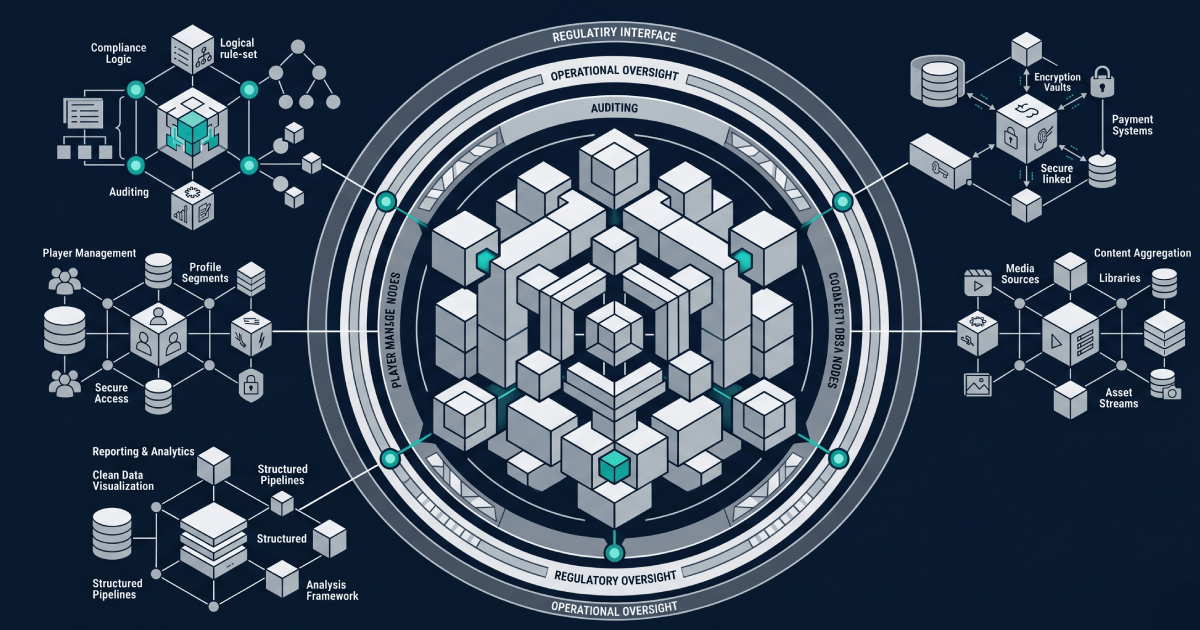
We design for containerized deployment on AWS, GCP, or Azure, with Kubernetes orchestration, but we’re also pragmatic about what needs to be a discrete microservice and what can stay as a well-bounded module within a larger service. Pure microservices architecture for an iGaming platform of moderate complexity can mean 80+ services, each with its own data store, deployment pipeline, and failure mode. That’s a significant operational burden. We typically land on a service-oriented architecture with 15-30 bounded services, decomposed along domain lines: player management, wallet, game integration, compliance, promotions, reporting.
The wallet is the heart of an iGaming platform, and it’s where most architectural mistakes create the most pain. A wallet service needs to handle real-time balance updates across concurrent game sessions, support multiple currencies and bonus balance types, maintain an immutable transaction ledger for regulatory audit, and do all of this at sub-100ms latency under peak load.
We build wallet services with event-sourced transaction logs. Every balance change is an immutable event, not a mutable row update. This gives you a complete, auditable history of every transaction by design. It also enables real-time streaming of wallet events into your fraud and AML monitoring pipeline, which becomes directly relevant when we discuss compliance architecture.
Bonus wallet separation is a common source of bugs and regulatory findings. UKGC-regulated operators need clear separation between real-money and bonus balances, with wagering contribution tracked at the transaction level. We’ve seen platforms where bonus balance logic was implemented as application-layer calculation rather than wallet-level accounting. That works until it doesn’t, usually when an auditor asks you to prove a specific player’s bonus balance history.
Over 70% of sessions for most operators we work with originate on mobile devices. Despite this, many platforms still treat mobile as a responsive wrapper around a desktop experience. We build mobile-first, which means the primary design target is a 375px viewport, the performance budget is set against 4G network conditions, and the interaction model assumes touch input. Desktop becomes the progressive enhancement rather than the other way around.
This has real consequences for player retention. A 200ms improvement in page load time on mobile isn’t a vanity metric. It correlates directly with session length and deposit conversion rates.
Our client work demonstrates what we’ve described above in practice.
For Rank Group, we delivered platform engineering work for one of the UK’s largest regulated gaming operators. The challenge was the complexity inherent in operating multiple well-known brands (including Mecca Bingo) under stringent UKGC requirements, where platform changes carry regulatory implications that extend beyond the purely technical. Working with Rank Group’s teams, we addressed the architectural and compliance considerations that come with operating at this scale in one of the world’s most tightly regulated markets.
For DAZN, we worked on enterprise web platform development for a global sports media business operating at significant scale. While not a traditional iGaming operator, the technical requirements overlap substantially: high-concurrency event-driven architectures, real-time data processing, and the need for platform reliability during peak sporting events where downtime has immediate commercial consequences.
These engagements reinforced a consistent lesson: the operators who succeed with platform development are the ones who treat it as a business capability investment, not a technology project. The technology serves the commercial and regulatory objectives. When those objectives are clear, the engineering follows.
Results Are Designed, Not Hoped For
Clear Objectives. Tangible Outcomes.
Well engineered software is only part of the equation. True impact comes from aligning technology with commercial intent from the outset.
We define success early, measure consistently and refine continuously to ensure every product delivers meaningful and sustained value.

Our Development Process: Clarity, Collaboration, and Outcomes
We run a structured process, not because we’re attached to methodology for its own sake, but because iGaming platform projects have a specific failure mode: scope ambiguity in discovery leads to architectural rework in development, which leads to blown timelines and budget overruns.
Discovery and architecture runs two to four weeks. We map business requirements to technical architecture, identify integration points, define the compliance constraint set for each target jurisdiction, and produce a documented architecture decision record (ADR) covering the major trade-offs. This is where we push back. If an operator wants a fully decomposed microservices architecture but has a team of eight engineers, we’ll say so. Architecture should match organizational capacity, not aspirational org charts.
Iterative development follows two-week sprints with working software delivered at the end of each sprint. We use vertical slicing: each sprint delivers a thin but complete feature across the full stack (API, business logic, persistence, UI) rather than building layers horizontally. This means the operator sees working functionality early, which exposes misunderstandings before they’re expensive to fix.
Quality assurance includes automated testing at the unit, integration, and end-to-end levels. For iGaming platforms, we add specific test coverage for regulatory scenarios: self-exclusion enforcement across concurrent sessions, wallet balance consistency under concurrent game rounds, and bonus wagering calculation accuracy. These are the areas where bugs create regulatory findings, not just user complaints.
Post-launch support covers monitoring, incident response, and iterative improvement. We instrument platforms for observability from day one (structured logging, distributed tracing, metrics dashboards), because diagnosing a wallet reconciliation issue at 2am on a Saturday requires visibility, not guesswork.
Partner with Jadex Consulting to Engineer Your Market-Defining Platform
If you’re evaluating a platform build, a migration from white-label to custom, or a modernization of a platform that’s accumulated more technical debt than you’d like to admit, we should talk.
At Jadex Consulting, we bring direct experience in regulated iGaming markets, an engineering approach grounded in architectural trade-offs rather than vendor hype, and a track record with tier-one operators who face the same pressures you do. We won’t tell you that custom is always the right answer, or that microservices solve every problem, or that AI will fix your retention numbers. We will give you an honest assessment of where your platform stands, what it would take to get it where you need it, and whether the investment makes sense for your specific situation.
The operators gaining ground in UKGC, MGA, and GGC-regulated markets are the ones making deliberate platform decisions now, not reacting to regulatory deadlines six months from now. If you’re ready to scope what a purpose-built, compliant, and genuinely scalable platform looks like for your operation, reach out for a technical consultation. We’ll start with the hard questions.
Latest from our blog
Insights & Perspectives
Our insights explore the intersection of technology, commercial strategy and disciplined execution across complex digital environments.