Online Gambling Platform Development: A Strategic Framework for Operators
Most operators we speak with aren’t starting from zero. They’re running on a white-label that served them well at launch but now costs them 30-40% of GGR in revenue share while blocking the product differentiation they need. Or they’re sitting on a custom platform built five years ago that’s accumulated enough technical debt to make every UKGC compliance change a six-figure project. This article lays out the architectural decisions, cost realities, and strategic trade-offs involved in building, migrating, or modernising an iGaming platform in regulated markets.










The typical white-label lifecycle follows a predictable arc. An operator launches quickly, sometimes in under eight weeks, on a vendor’s platform. GGR grows. Then the constraints start compounding.
Revenue share models that seemed reasonable at £200k monthly GGR become punishing at £2m. Feature requests sit in the vendor’s backlog behind higher-priority clients. A new UKGC requirement around affordability checks needs implementing, but the vendor’s roadmap won’t accommodate it for another quarter, leaving you exposed. You want to launch in Ontario or a LatAm market, but the platform wasn’t architected for multi-jurisdictional deployment.
These aren’t hypothetical frustrations. They’re the conversations we have weekly with operators evaluating their options.
Legacy custom platforms carry a different set of problems. Monolithic architectures where the PAM, wallet, bonus engine, and compliance layer are tightly coupled mean that changing one component risks destabilising others. Database schemas designed for a single jurisdiction don’t accommodate the data residency and reporting requirements of a second or third licence. The original development team has moved on, and the codebase has limited documentation.
The decision to modernise or rebuild isn’t primarily technical. It’s commercial. The question is whether your current platform can absorb the next three years of regulatory change, market expansion, and product evolution without becoming the bottleneck. If the answer is no, or even “probably not,” the cost of inaction compounds faster than most operators realise.
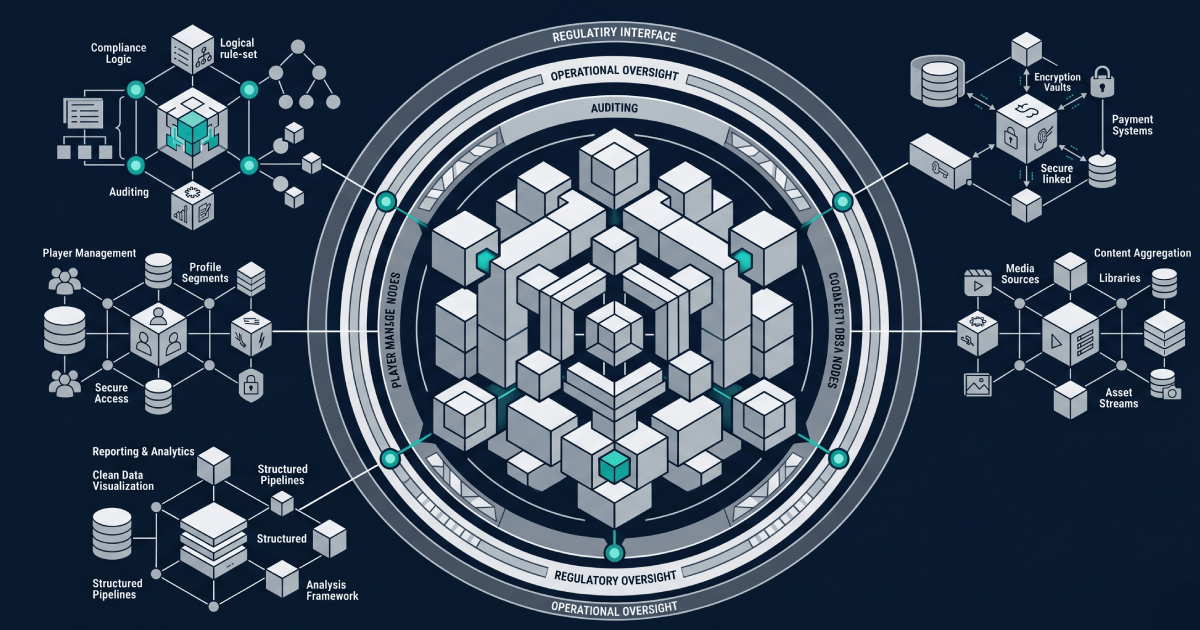
A production-grade iGaming platform rests on four interconnected systems. Getting any one wrong creates cascading problems across the others.
Player Account Management (PAM)
The PAM is the system of record for every player interaction. It handles registration, authentication, session management, KYC status, responsible gambling settings, and the player’s relationship with every other system on the platform. A poorly architected PAM becomes the single point of failure for everything downstream.
Modern PAM design demands an API-first approach. Every function (account creation, status changes, limit adjustments, self-exclusion triggers) should be exposed as a versioned API endpoint. This isn’t architectural purism. It’s what allows your compliance layer, CRM, bonus engine, and reporting systems to operate against a single source of truth without brittle point-to-point integrations.
Wallet and Payment Gateway
The wallet service needs to handle concurrent transactions at volume (think thousands of bet placements per second during a Premier League Saturday) while maintaining ACID compliance. Event-sourced wallet architectures, where every balance change is an immutable event rather than a mutable state, give you the auditability that regulators expect and the real-time transaction stream that AML monitoring requires.
Payment gateway integration is its own layer of complexity. You need to support multiple PSPs across jurisdictions, handle partial failures gracefully, manage chargebacks programmatically, and more accommodate cryptocurrency deposits where regulated. A microservices-based payment orchestration layer that can route transactions based on jurisdiction, amount, risk score, and PSP availability is worth the architectural investment.
Game Aggregator API
Integrating directly with 40+ game providers is technically possible and commercially inadvisable for most operators. A game aggregator provides a single API that normalises the integration with hundreds of game studios. The trade-off is clear: you sacrifice some control over the direct provider relationship in exchange for dramatically faster content deployment and reduced integration maintenance.
The architectural consideration here is the game round lifecycle. Your platform needs to handle game round opens, wins, losses, and cancellations as atomic transactions against the wallet. Race conditions between the game server callback and the wallet update are where money goes missing. We’ve inherited platforms where this boundary was loosely defined, and reconciliation was a daily manual process.
Regulatory and Compliance Layer (RegTech)
This isn’t a bolt-on. It’s a first-class architectural component. The compliance layer needs to intercept player activity in real time: monitoring deposit velocity for affordability triggers, flagging transaction patterns for AML review, enforcing session duration limits, and managing self-exclusion across brands and jurisdictions.
Building this as an event-driven system that consumes from the same event stream as the wallet and PAM allows you to add new compliance rules without modifying the core transaction path. When the UKGC publishes new affordability check thresholds (and they will), you’re configuring rules, not rewriting code.
We push operators to model TCO over a five-year horizon because the initial build cost is often the smaller number.
Initial development or setup: White-label (£20k-£80k), turnkey (£100k-£300k), custom (£300k-£2m+). These ranges vary based on jurisdiction count, integration scope, and regulatory requirements.
Licensing costs per jurisdiction: A UKGC licence application runs £5k-£30k depending on licence type, with annual fees of £3k-£60k based on GGR bands. MGA licences involve a €25k application fee plus annual compliance costs. Each additional jurisdiction adds both the direct licensing cost and the engineering cost of implementing jurisdiction-specific requirements.
Game provider fees: Aggregators typically charge 10-15% of the GGR generated through their content, on top of any setup fees. Direct integrations avoid the aggregator margin but require dedicated integration and ongoing maintenance resources.
Payment processing: Expect 2-5% of transaction value depending on payment method, geography, and volume. Crypto processing is typically cheaper per transaction but adds compliance complexity.
Ongoing infrastructure and maintenance: For a custom platform, budget 15-25% of initial build cost annually for infrastructure, security, performance monitoring, and incremental feature development. This is where operators consistently under-budget.
Compliance and regulatory change: UKGC regulatory updates alone have required multiple platform changes per year over the past three years. Budget for ongoing compliance engineering as a dedicated capacity allocation, not a project-by-project cost.
The operators who get burned are those who compare the setup cost of a white-label against the build cost of a custom platform without modelling the compounding GGR revenue share over five years. At £2m monthly GGR with a 35% revenue share, you’re paying £8.4m annually to your white-label provider. That changes the economics considerably.
Results Are Designed, Not Hoped For
Clear Objectives. Tangible Outcomes.
Well engineered software is only part of the equation. True impact comes from aligning technology with commercial intent from the outset.
We define success early, measure consistently and refine continuously to ensure every product delivers meaningful and sustained value.

Integrating Game Aggregators and Payment Systems
Game aggregator integration is straightforward in concept and complex in execution.
The aggregator provides a single API that handles game discovery (lobby data, metadata, thumbnails), game launch (generating authenticated session URLs), and the game round lifecycle (bet, win, loss, rollback). The complexity lives in the details. How do you handle a game round callback that arrives after the player’s session has expired? What happens when the aggregator’s API times out mid-round? How do you reconcile your wallet balance against the aggregator’s transaction log when they inevitably disagree?
We’ve found that operators who treat the aggregator integration as a “plug and play” exercise spend more time on post-launch reconciliation and bug fixing than those who invest in thorough integration testing upfront. Build a game round simulator that can replay edge cases (network timeouts, duplicate callbacks, out-of-order events) against your wallet before going live with real money.
Payment system integration follows a similar pattern. The PSP provides an API for initiating deposits, processing withdrawals, and receiving status webhooks. The engineering work is in the orchestration: routing a deposit to the optimal PSP based on the player’s jurisdiction, payment method, and your current processing rates; handling partial failures where the PSP charges the player but the webhook fails to reach your platform; and managing withdrawal queues that enforce AML checks, responsible gambling cooling-off periods, and fraud rules before releasing funds.
Multi-currency support adds another layer. If you operate across EUR, GBP, and USD jurisdictions, you need to decide whether the wallet stores balances in a base currency with real-time conversion, or maintains separate currency wallets per player. Each approach has implications for FX risk, reporting accuracy, and bonus calculation.
We’re going to be direct about AI in iGaming: most operators’ data infrastructure isn’t ready for the ML models vendors are selling them.
Effective AI-driven personalisation requires a unified, real-time player data model that captures behavioural events (game launches, session durations, bet patterns), transactional data (deposit and withdrawal history), and contextual data (device, time of day, location). If your platform stores this data across siloed systems with inconsistent schemas and batch ETL processes, no ML model will produce useful predictions.
The practical path is to get your data infrastructure right first. Implement event streaming (Kafka or equivalent) across your platform so that every player action produces a structured event. Build a player data lake that your analytics, CRM, and future ML systems can query. Once that foundation exists, you can deploy ML models for churn prediction, real-time offer optimisation, and fraud scoring that actually work in production rather than just in a vendor demo.
Crypto casino functionality is growing in regulated markets, though “regulated” is the operative word. Offering crypto deposits under a UKGC licence requires the same KYC/AML rigour as fiat currency, plus blockchain-specific transaction monitoring. The engineering cost of adding crypto support properly is higher than most operators expect.
AR/VR in gaming remains largely experimental. Live dealer innovation, improved streaming quality, and social features are more likely to move retention metrics in the near term than immersive headset experiences.
Building Your Strategic Asset: The Case for a Custom Platform
The operators who achieve sustained competitive advantage in regulated iGaming markets are, without exception, the ones who control their platform.
This doesn’t mean every operator should build from scratch. It means that platform ownership, whether achieved through custom development, deep customisation of a turnkey solution, or a phased migration from white-label, should be the strategic objective. The operators locked into revenue share agreements with limited product control are the ones most vulnerable to regulatory change, market shifts, and competitive pressure.
At Jadex Consulting, we’ve helped operators across this spectrum: from scoping greenfield platform builds to planning phased migrations off legacy systems. The right approach depends on where you are today, where you need to be in three years, and what you can realistically execute given your team, timeline, and capital.
The investment in a custom platform compounds over time. Every feature you build, every integration you own, every compliance capability you engineer internally becomes part of an asset that appreciates rather than depreciates. The white-label fee you pay this month is gone. The platform you build this year still serves you in year five.
If you’re evaluating your platform strategy this quarter, we’d welcome the conversation. Not a sales pitch. A technical discussion about your architecture, your constraints, and the realistic paths forward.
Latest from our blog
Insights & Perspectives
Our insights explore the intersection of technology, commercial strategy and disciplined execution across complex digital environments.