Online Casino Software Development: An Operator’s Technical Guide
Most platform decisions that haunt operators for five years get made in five weeks. The architecture you commit to today determines your compliance cost trajectory, your speed to new markets, your ability to retain players through personalisation, and your exit valuation. This article breaks down the real technical and commercial trade-offs across platform models, core architecture, game integration, payments, compliance, security, cost modelling, and partner selection, so you can make those decisions with full visibility.









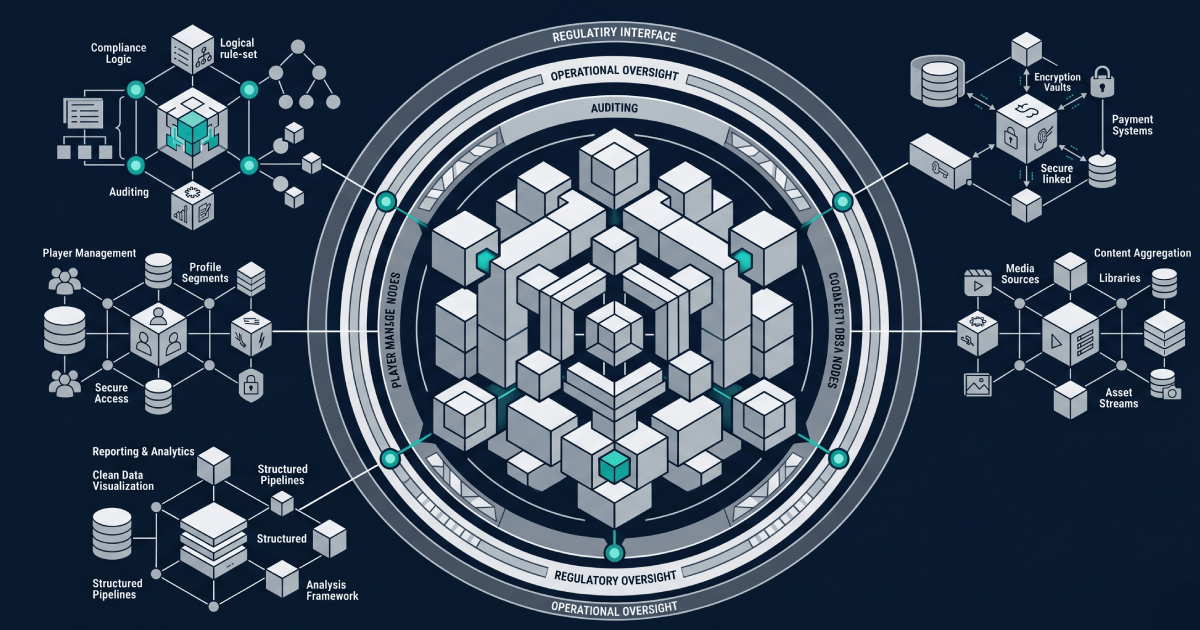
Three models dominate the market. Each carries assumptions about your operational maturity, regulatory ambitions, and tolerance for dependency.
Turnkey platforms give you a ready-made product: front-end, back-office, game content, payment integrations, and often a licence bundled in. You’re live in weeks. The trade-off is that you’re operating on someone else’s infrastructure, with limited ability to differentiate. You share the platform with other operators, which means shared roadmaps, shared priorities, and often shared player databases with the provider acting as the data controller. For a new entrant testing market viability, turnkey makes sense. For anyone building a brand with long-term retention strategy, you’ll hit the ceiling fast.
White-label solutions sit one step above turnkey. You get your own brand, some configuration options, and typically a dedicated account manager. But the underlying platform remains the vendor’s. Revenue share models (often 10-15% of GGR) erode margins as you scale. Feature requests queue behind the vendor’s roadmap priorities. Regulatory changes in your jurisdiction may not align with the vendor’s development cycle. We’ve seen operators stuck waiting six months for a deposit limit configuration change required by UKGC enforcement action, because the vendor’s sprint backlog was focused on a different market.
Custom development means you own the code, the architecture decisions, and the technical debt. Initial build costs are higher (we’ll get specific on numbers later). Time to market is longer. But you control your compliance posture, your integration strategy, your data, and your ability to iterate without asking permission. The risk here is different: you need the engineering capability to maintain and evolve the platform, and you carry the full burden of regulatory certification.
The honest framing: build vs. buy isn’t a binary. Many operators we work with run a hybrid, launching on a white-label to validate a market, then migrating core systems (PAM, wallet, bonus engine) to owned infrastructure once unit economics justify the investment. The migration itself is a project worth scoping carefully, because running dual systems during cutover while maintaining regulatory compliance is where most operators underestimate effort.
Game aggregators like SoftSwiss, EveryMatrix, or Pragmatic Solutions offer a single integration point for hundreds of game studios. One API, one wallet callback format, one set of certification requirements. For most operators, this is the pragmatic choice for initial content coverage.
But aggregators take a cut, typically 1-3% of GGR from the games served through their platform. On a £50M GGR operation, that’s £500K to £1.5M annually. At that scale, direct integrations with your top-performing studios (your top 10 studios likely drive 60-70% of play) start making financial sense.
The technical challenge with direct integrations is variance. Every studio has its own API specification, authentication model, and round settlement logic. Some use synchronous wallet calls during gameplay; others batch-settle. Some support free round APIs cleanly; others require workarounds. Each direct integration needs individual certification per jurisdiction, which adds regulatory overhead.
The practical approach: use an aggregator for breadth, go direct for your highest-volume studios, and build an internal abstraction layer that normalises game launch, wallet interaction, and reporting regardless of source. This abstraction layer is worth the upfront investment because it decouples your platform from any single aggregator’s contract terms or technical limitations.
Live dealer content (Evolution, Pragmatic Live, Playtech Live) often requires separate integration work due to streaming infrastructure requirements, table-level capacity management, and dedicated lobby APIs. Don’t assume your slots aggregator integration covers live dealer out of the box.
Development cost figures without context are meaningless. But operators need realistic ranges to model business cases, so here’s how we frame it.
Turnkey/white-label setup: £20K-100K initial, plus 10-15% of GGR ongoing, plus per-player or per-transaction fees from some providers. At £5M GGR, the revenue share alone is £500K-750K annually. At £20M GGR, it’s £2-3M. That’s the number that typically triggers the build conversation.
Custom platform build: £500K-2M+ for initial development, depending on scope. A single-jurisdiction, single-brand platform with aggregator-sourced content and standard payment methods sits at the lower end. Multi-jurisdiction, multi-brand, with direct studio integrations, a proprietary bonus engine, and custom sportsbook integration pushes well beyond £2M.
Ongoing costs are where operators consistently underestimate. Plan for:
- Hosting and infrastructure: £8K-25K monthly depending on player volume and whether you’re running managed Kubernetes, serverless, or traditional VM infrastructure
- Licensing and certification: £50K-200K annually across jurisdictions
- Third-party service costs: KYC providers, payment gateway fees, game aggregator commissions, CDN, monitoring
- Engineering team: maintaining a regulated platform requires 4-8 engineers minimum for a single-jurisdiction operation, more for multi-market
- Compliance-driven development: budget 25-35% of engineering capacity for regulatory change in UKGC-regulated markets
The three to five year TCO comparison is where the build case often wins. A white-label at £20M GGR costs £6-9M in revenue share over three years. A custom build with the same GGR costs £2-3M upfront plus £1-2M annually in maintenance and infrastructure. The breakeven typically falls in year two for operators above £15M GGR, assuming competent delivery.
Results Are Designed, Not Hoped For
Clear Objectives. Tangible Outcomes.
Well engineered software is only part of the equation. True impact comes from aligning technology with commercial intent from the outset.
We define success early, measure consistently and refine continuously to ensure every product delivers meaningful and sustained value.

Future-Proofing Your Platform: AI, Personalisation, and Scalability
AI in iGaming is real, but the gap between vendor demos and production deployments is wide. Personalised game recommendations, dynamic bonus targeting, and churn prediction models all work, provided your data infrastructure supports them. That means an event stream of player activity (not batch ETL from a reporting database), a feature store for model inputs, and a serving layer that can return predictions within the latency budget of a page load.
If your platform can’t produce a unified, real-time view of player behaviour across game sessions, deposits, bonus interactions, and support contacts, no ML vendor’s model will perform in production regardless of how good their pitch deck looks. Fix the data pipeline first.
Scalability is an architectural property, not a feature you add later. Horizontal scaling of stateless services, database read replicas for reporting workloads, and async processing for non-critical paths (email, reporting, analytics) should be in the initial architecture. Retrofitting scalability into a monolithic platform that wasn’t designed for it costs more than building it correctly from the start.
Mobile performance deserves specific attention. Over 70% of play on most operators’ platforms comes from mobile devices. This isn’t just about responsive design. It’s about API payload sizes, image optimisation, service worker caching for lobby content, and measuring Core Web Vitals against player session metrics. A 200ms increase in game launch time correlates with measurable drops in sessions per player per day.
Scoping Your Platform Build: Next Steps
The decisions covered here aren’t independent. Your platform model choice constrains your compliance approach. Your wallet architecture determines what your fraud and AML systems can do. Your game integration strategy affects your content cost structure, which affects your GGR margin, which determines when a custom build pays for itself.
Start with three questions: What’s your GGR trajectory over three years? Which jurisdictions will you operate in, and which are you likely to enter? What’s the one capability your current platform can’t deliver that’s costing you players or margin?
Those answers shape the architecture, the build-vs-buy boundary, and the investment case. If you’re working through these decisions now, we scope platform builds and migrations for regulated operators across UKGC, MGA, and GGC jurisdictions. Reach out to discuss your specific constraints, and we’ll give you an honest assessment of what the build looks like, what it costs, and where the real risks sit.
Latest from our blog
Insights & Perspectives
Our insights explore the intersection of technology, commercial strategy and disciplined execution across complex digital environments.