Casino Backend Development for Enterprise iGaming Operators
Most white-label platforms were sold on a promise: fast time-to-market, shared infrastructure costs, and a managed compliance layer. What operators actually got was revenue share that compounds against you, a product roadmap controlled by someone else, and a compliance layer that’s always six months behind the latest UKGC LCCP update.
If you’re reading this, you’re likely past the point of accepting those constraints. You’re evaluating whether to build, buy, or modernise, and you need specifics, not another vendor deck with a hexagonal architecture diagram and no mention of what happens when the Gambling Commission changes its source of funds requirements mid-quarter.










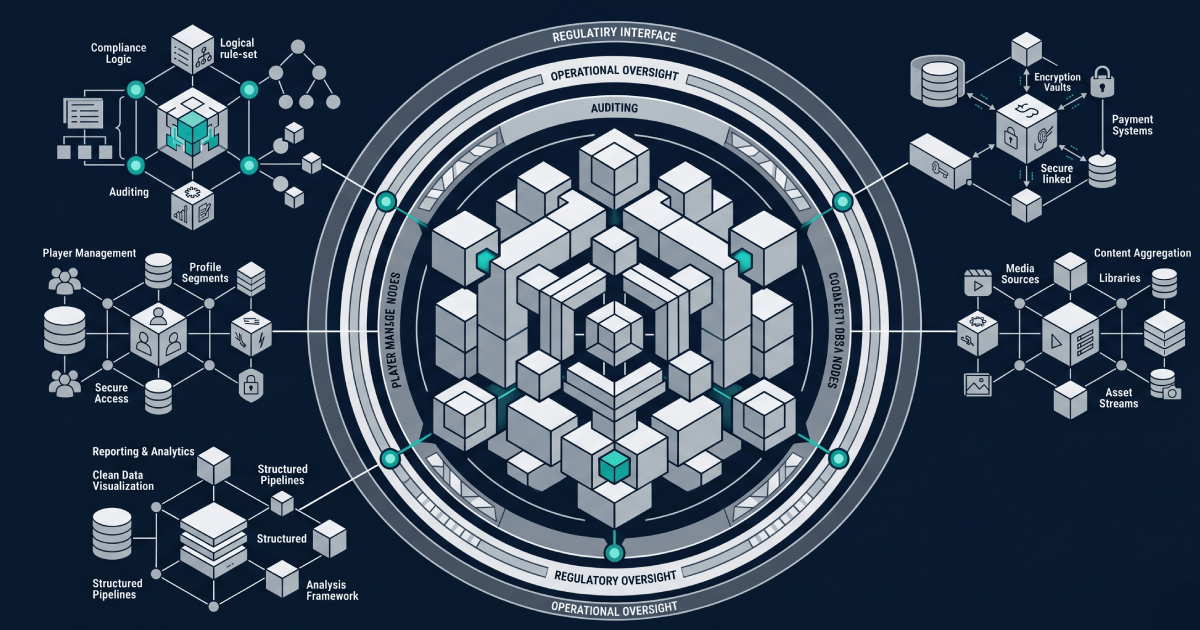
A casino backend is not a single application. It’s a coordinated system of services, each with distinct performance, security, and compliance requirements. Breaking down what’s actually in scope matters, because underestimating the surface area is where most platform projects go wrong.
Game logic and RNG. The game logic engine enforces rules, calculates payouts, and manages game state. For operators hosting proprietary games, this includes a certified Random Number Generator. RNG certification (typically to ISO 17025 via accredited test houses like GLI or BMM) is a gating requirement, not something you bolt on post-launch.
Wallet service. This is where most architectural debt accumulates. A single-wallet model that handles deposits, withdrawals, bonus balances, and real-money game transactions in one monolithic service quickly becomes the bottleneck for everything: fraud detection, bonus abuse prevention, real-time AML monitoring, and basic transaction reporting. We’ll come back to this.
Player account management. Registration, authentication, session management, KYC status tracking, self-exclusion state, and responsible gaming tool configuration. This service must maintain a canonical player state that multiple downstream services consume. Getting the data model wrong here creates cascading problems.
Payment orchestration. Not just a single payment gateway integration, but a routing layer that manages multiple PSPs, handles deposit method preferences by jurisdiction, processes withdrawals against AML hold rules, and reconciles across providers. Payment failure handling alone is a non-trivial engineering problem.
Backoffice and CRM tooling. Operator-facing dashboards for player management, manual KYC adjudication, bonus configuration, financial reporting, and compliance case management. This layer is often underspecified in initial builds and then becomes a constant source of operational friction.
Reporting and analytics. Regulatory reporting (SAR filing, player activity reports for UKGC Annual Assurance statements), commercial reporting (GGR, NGR, player LTV), and operational monitoring. These have different latency requirements, different data models, and should not all be served from the same database.
Stack selection matters less than most CTOs think it does, with a few exceptions.
Python with FastAPI is a strong choice for API services where development speed and async performance matter. The async capabilities handle concurrent API calls to game providers and payment gateways without the thread management overhead. We use it extensively for integration-heavy services.
.NET remains the dominant stack in the iGaming industry for a reason: strong typing, mature tooling, and a large pool of developers with iGaming experience. If you’re building a team in Malta or Gibraltar, .NET developers with casino platform experience are easier to hire than Python developers with the same domain knowledge. That’s a practical factor that matters more than benchmark comparisons.
Go is worth considering for high-throughput, low-latency services like the wallet or event processing pipeline. The concurrency model is well-suited to the workload pattern.
Containerisation is non-negotiable. Docker for packaging, Kubernetes for orchestration. The ability to deploy and scale services independently, run consistent environments across development and production, and roll back deployments when a UKGC compliance patch needs to ship at 2am on a Friday (and it will) depends on having this infrastructure in place.
The stack you can hire for, maintain, and operate in production matters more than the stack that performs best in a conference talk demo.
Results Are Designed, Not Hoped For
Clear Objectives. Tangible Outcomes.
Well engineered software is only part of the equation. True impact comes from aligning technology with commercial intent from the outset.
We define success early, measure consistently and refine continuously to ensure every product delivers meaningful and sustained value.

The Integration Layer: RGS and Payment Gateways
No operator builds every game in-house. The Remote Game Server integration layer is where your platform connects to the game studios that supply your content.
Most operators work through aggregators (SoftSwiss, EveryMatrix, Pragmatic Solutions) that provide a single integration point to hundreds of studios. The trade-off: aggregators simplify integration but add latency, take a margin, and limit your ability to negotiate direct commercial terms with high-performing studios.
A well-architected integration layer supports both aggregated and direct RGS connections. The game abstraction layer should normalise the interface so that upstream services (lobby, wallet, reporting) don’t need to know whether a game is served via aggregator or direct integration. This is harder than it sounds, because each aggregator has its own wallet callback pattern, session management approach, and error handling behaviour.
Payment gateway integration follows a similar pattern. Multiple PSPs (Worldpay, Nuvei, Trustly, various local payment methods per jurisdiction) behind an orchestration layer. The orchestration layer handles routing logic (which PSP for which payment method in which jurisdiction), failover (if Worldpay is down, route to the backup), and reconciliation (matching settlement files from multiple providers against your internal transaction records).
The integration layer is where operational stability lives or dies. A payment integration that fails silently, or an RGS callback that times out without proper retry logic, creates player-facing incidents that damage retention.
Building Your Next-Generation iGaming Platform with Jadex
Moving from a white-label or legacy monolith to a modern platform is a multi-year programme. Getting the architecture right in the first six months determines the cost trajectory for the next five years.
At Jadex, we’ve delivered platform engineering for tier-one operators including Rank Group and DAZN Bet. We understand the gap between what looks right in a system design document and what actually works when a UKGC compliance change lands with a 12-week implementation deadline.
We don’t advocate a single architectural pattern as universally correct. We help operators assess their specific constraints (regulatory jurisdictions, player volume, existing technical capability, commercial model) and make architecture decisions that are honest about trade-offs. Sometimes the right answer is a phased migration, not a ground-up rebuild. Sometimes a monolith with clean internal boundaries is better than a premature microservices decomposition.
If you’re scoping a platform build, evaluating a migration, or trying to understand the true cost of modernising your backend architecture, we should talk. Not about what’s theoretically possible, but about what’s practically deliverable given your regulatory environment, your team, and your timeline.
Latest from our blog
Insights & Perspectives
Our insights explore the intersection of technology, commercial strategy and disciplined execution across complex digital environments.