Online Bingo Software Development for Regulated Operators
Most bingo operators running white-label platforms will hit the same wall within 18 to 24 months: a compliance change drops from the UKGC, and your vendor’s roadmap puts the required platform changes three sprints behind their own priorities. You’re paying revenue share on a platform you can’t modify, can’t differentiate, and can’t adapt at the speed your market demands. This article breaks down the architecture, regulatory engineering, cost realities, and development process behind building a custom bingo platform for regulated markets, with enough technical specificity to inform actual procurement and build decisions.








White-label bingo solutions solve one problem well: speed to market. You get a functional platform, a game library, payment processing, and a basic back-office in weeks rather than months. For operators testing a new vertical or entering a market with minimal capital, that trade-off makes sense.
The economics change after year one.
Revenue share models typically run between 15% and 40% of GGR, depending on the provider and the deal structure. At scale, that cost dwarfs what a custom platform would cost to build and maintain. An operator generating £3M in monthly bingo GGR on a 25% rev share is transferring £750K per month to a platform vendor. Over a three-year horizon, that’s £27M. A custom platform build, including ongoing maintenance and a dedicated engineering team, rarely approaches that figure for a single-vertical operation.
But cost isn’t the strongest argument. Control is.
On a white-label, you’re constrained by the vendor’s feature roadmap, their integration partnerships, their deployment schedule. Want to integrate a specific payment provider popular in your target demographic? You wait. Want to build a proprietary bonus mechanic that differentiates your brand? You negotiate. Want to change your wallet architecture to support real-time fraud scoring? You’re told it’s “on the roadmap.”
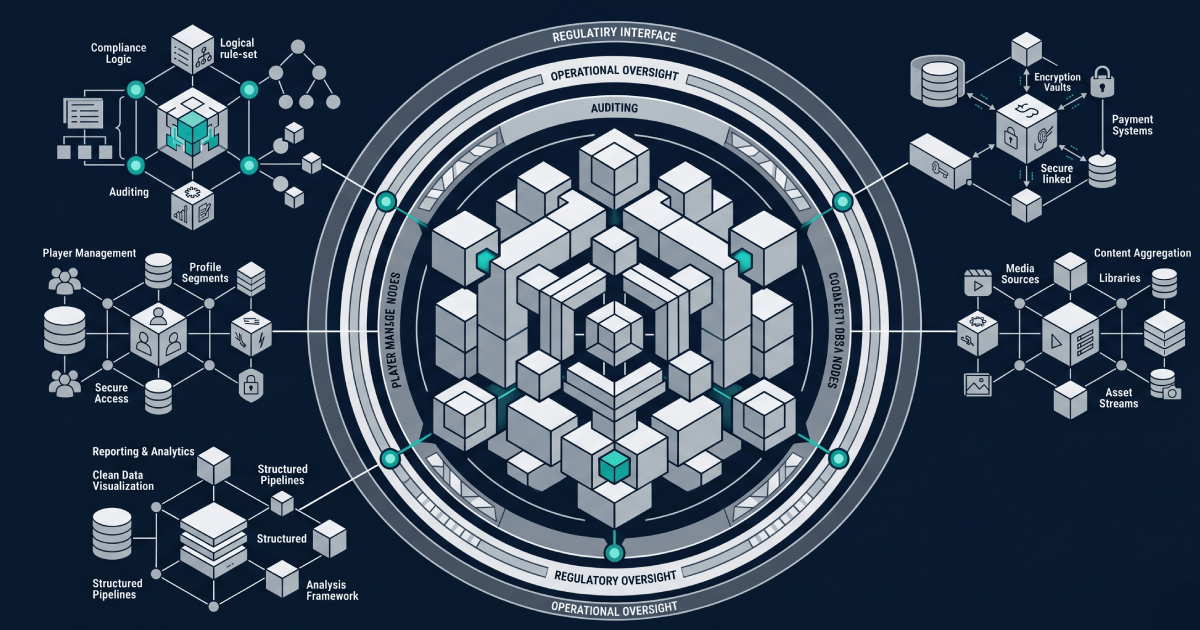
A custom bingo platform gives you direct ownership of the game logic layer, the player account management system, the bonus engine, and the data pipeline. You control release cadence. You decide which game aggregators to integrate. You build the compliance tooling that matches your specific licence conditions, not a lowest-common-denominator interpretation that covers the vendor’s entire client base.
The honest trade-off: a custom build demands sustained engineering investment, operational maturity, and the willingness to own platform reliability. Operators without in-house technical leadership, or without the commercial scale to justify the investment, should not build custom. White-label platforms exist for a reason. But if you’re at the scale where vendor dependency is costing you more than engineering headcount would, the maths shift decisively.
A custom platform’s player-facing advantage comes down to one thing: you’re not constrained to a shared template that 15 other operators are also running.
Bespoke 2D and 3D graphics, custom game skins, and unique bingo room themes become possible when you own the front-end layer. More importantly, you can develop proprietary bingo variants (hybrid games, progressive jackpots with custom trigger mechanics, side-bet features) that exist nowhere else in the market. That’s a genuine competitive moat. A white-label operator running the same 90-ball and 75-ball games as every other client on that network cannot compete on product differentiation.
Real-time chat is a core feature of bingo, not an add-on. The social layer drives session length and return visits. A custom chat system supports moderated rooms, chat games (embedded mini-games triggered by chat moderators), and community features that build player loyalty beyond the bingo product itself.
Tournament modules, leaderboards, and achievement systems layer engagement mechanics on top of the core game. These need to integrate cleanly with the bonus engine, so tournament prizes can trigger bonus awards without manual intervention.
An API-first, headless architecture means your front-end team can build native mobile experiences, progressive web apps, and desktop clients against the same backend services. Mobile-responsive design isn’t enough. Players expect native-feeling performance on mobile devices, and that means purpose-built front-end clients, not responsive CSS applied to a desktop-first application.
Back-office capabilities determine how efficiently your operations team can run the platform day-to-day. The admin portal needs to cover:
User management with role-based access control. Your compliance team needs different permissions than your marketing team. Your customer support agents need player search and account review without access to financial configuration.
Game management covering room scheduling, ticket pricing, jackpot seeding, and variant configuration. Operators need to adjust room schedules based on player demand patterns without requiring a code deployment.
Financial reporting with real-time and historical views. GGR, NGR, deposit/withdrawal volumes, bonus cost, and duty calculations per jurisdiction. These reports feed your regulatory submissions and must reconcile to the penny with your wallet service transaction logs.
Customer support modules that surface player history, transaction records, chat logs, and responsible gaming interactions in a single view. When a player contacts support about a disputed win, the agent needs the complete audit trail within seconds.
The BI layer is where platform ownership pays dividends. You own the data. Your analytics pipeline can ingest every player action, every game event, every transaction, and feed it into your own data warehouse. You can build propensity models for churn prediction, segment players by behaviour patterns, and personalise the experience based on actual data rather than the aggregate insights a white-label vendor shares across their network.
Operators on shared platforms are working with anonymised, aggregated data at best. With a custom platform, your data science team has access to raw event streams. That difference is the gap between generic promotional calendars and genuinely data-driven player lifecycle management.
Results Are Designed, Not Hoped For
Clear Objectives. Tangible Outcomes.
Well engineered software is only part of the equation. True impact comes from aligning technology with commercial intent from the outset.
We define success early, measure consistently and refine continuously to ensure every product delivers meaningful and sustained value.

Our Platform Development Lifecycle: A Transparent Partnership
The development process follows a structure designed to manage risk, particularly the risk of building a platform that works technically but misses regulatory or commercial requirements.
Discovery and technical scoping takes four to six weeks. This phase produces a detailed technical specification, architecture decision records, a compliance requirements matrix mapped to target jurisdictions, and a prioritised feature backlog. Your technical team is involved throughout. We’re not disappearing into a room and returning with a document. We’re working through architectural decisions together: which trade-offs are acceptable, where to invest in custom development versus integrating third-party services, and what the MVP looks like versus the full roadmap.
Architectural design and prototyping produces service interface definitions, data models, infrastructure-as-code templates, and interactive prototypes of key user flows. The prototyping phase is where we validate assumptions about player experience and back-office usability before committing to full development.
Agile development sprints run in two-week cycles with demo sessions at each sprint boundary. Your product owner participates in sprint planning and review. This isn’t a black-box engagement where you see the platform six months later. You’re reviewing working software every two weeks.
QA and compliance testing runs in parallel with development, not sequentially after it. Automated test suites cover game logic validation, wallet transaction integrity, and API contract verification. Manual testing covers UX flows, responsible gaming feature behaviour, and edge cases in multi-jurisdiction configuration. Compliance testing validates that the platform meets the specific technical standards of each target jurisdiction before submission to testing labs.
Staged deployment means soft launch with controlled player groups before full migration. For operators moving from a white-label, this phase includes a migration plan that maintains operational continuity: player accounts, transaction histories, and bonus balances must transfer cleanly.
The technology choices are driven by the requirements, not by trend-chasing. That said, certain patterns are well-proven for this domain.
Backend services are typically built in Java or Node.js, depending on the performance profile of each service. The game engine and wallet service, where transaction integrity and low latency are important, benefit from Java’s mature concurrency tooling. Services with high I/O requirements and less computational intensity (chat, notifications, API gateway) fit Node.js well.
Frontend applications use React for web clients, with shared component libraries that enable consistent UX across bingo rooms, account management, and responsible gaming interfaces. Native mobile development where the performance case justifies it.
PostgreSQL serves as the primary relational datastore. Its JSONB support handles the schema flexibility needed for multi-jurisdiction configuration without sacrificing transactional integrity. Event streaming via Kafka or similar enables the real-time data pipeline that feeds AML monitoring, BI tooling, and personalisation services.
Cloud deployment on AWS or Azure, depending on the operator’s existing infrastructure and data residency requirements. Infrastructure-as-code (Terraform, CloudFormation) ensures reproducible environments and supports multi-region deployment for latency and compliance reasons.
The API-first, headless architecture philosophy means every capability exposed through the platform is available via documented, versioned APIs. This enables multi-brand deployment from a single backend, third-party front-end development, and integration with existing operator systems (CRM, marketing automation, data warehouse) without custom backend work.
Game aggregator integration (Pragmatic Play, Evolution, Relax Gaming, and others) sits behind a unified integration layer. Adding a new aggregator means implementing their specific API against a common internal contract, rather than touching the platform’s core services.
Begin Your Platform Modernisation Journey
If you’re currently evaluating whether to migrate from a white-label, modernise a legacy platform, or scope a new custom bingo build, the next step is a technical consultation focused on your specific platform challenges.
This isn’t a sales call. It’s a working session with engineers who’ve built and shipped bingo platforms for operators at the scale you’re operating or targeting. Bring your architecture diagrams, your pain points, your compliance requirements, and your commercial constraints. We’ll give you an honest assessment of whether a custom build makes sense for your situation, what the realistic timeline and cost range looks like, and where the risks sit.
The operators who get the most from these conversations come prepared with three things: their current platform’s technical limitations documented, their target jurisdiction list for the next 24 months, and their honest assessment of in-house engineering capacity. That gives us enough to have a substantive conversation about your specific roadmap rather than abstract possibilities.
Schedule a technical consultation to start scoping your platform strategy.
Frequently Asked Questions
Latest from our blog
Insights & Perspectives
Our insights explore the intersection of technology, commercial strategy and disciplined execution across complex digital environments.