Building a Custom Bingo Platform: An Engineering Perspective for iGaming Operators
Most operators running bingo on a white-label network already know the problem: you’re paying 30-40% revenue share for a platform you can’t meaningfully differentiate, serving players from a shared liquidity pool you don’t control, on a roadmap set by someone else’s priorities. This article lays out the architectural decisions, regulatory constraints, and cost realities of building a custom bingo platform, so you can evaluate whether the investment case holds for your operation over a three to five year horizon.









White-label bingo networks solved a real problem a decade ago. They gave operators a fast path to market with pre-certified game engines, shared liquidity across network skins, and bundled compliance packages. The trade-off was understood: you sacrifice control for speed.
That trade-off has aged badly.
Shared liquidity pools, once the primary draw, now work against mid-tier operators. Your marketing spend drives players to rooms where they sit alongside players from competing skins. The network benefits; your retention metrics don’t. When liquidity drops below the threshold needed to fill rooms at off-peak hours, every skin suffers equally, and none can solve it independently.
The commercial constraints compound over time. Revenue share models that looked acceptable at launch become punitive as GGR scales. You can’t build proprietary jackpot structures. You can’t run bespoke bonusing mechanics tied to your loyalty programme. You can’t control the mobile experience beyond surface-level theming. Every skin on the network looks and feels fundamentally the same.
The strategic case for a custom platform isn’t about vanity. It’s about owning three things: the player relationship, the product roadmap, and the commercial model. Operators who control their game engine can create variants the network will never support. Operators who own their PAM can build responsible gaming tooling that goes beyond regulatory minimums and becomes a genuine differentiator in UKGC relicensing conversations. Operators who own their infrastructure can deploy to new jurisdictions without waiting eighteen months for the network to prioritise it.
The question isn’t whether custom is better in the abstract. It’s whether your operation has the scale, the technical ambition, and the commercial patience to make the investment pay back.
The reflexive answer in 2024 is microservices. The correct answer depends on your team, your scale, and how much operational complexity you’re willing to absorb.
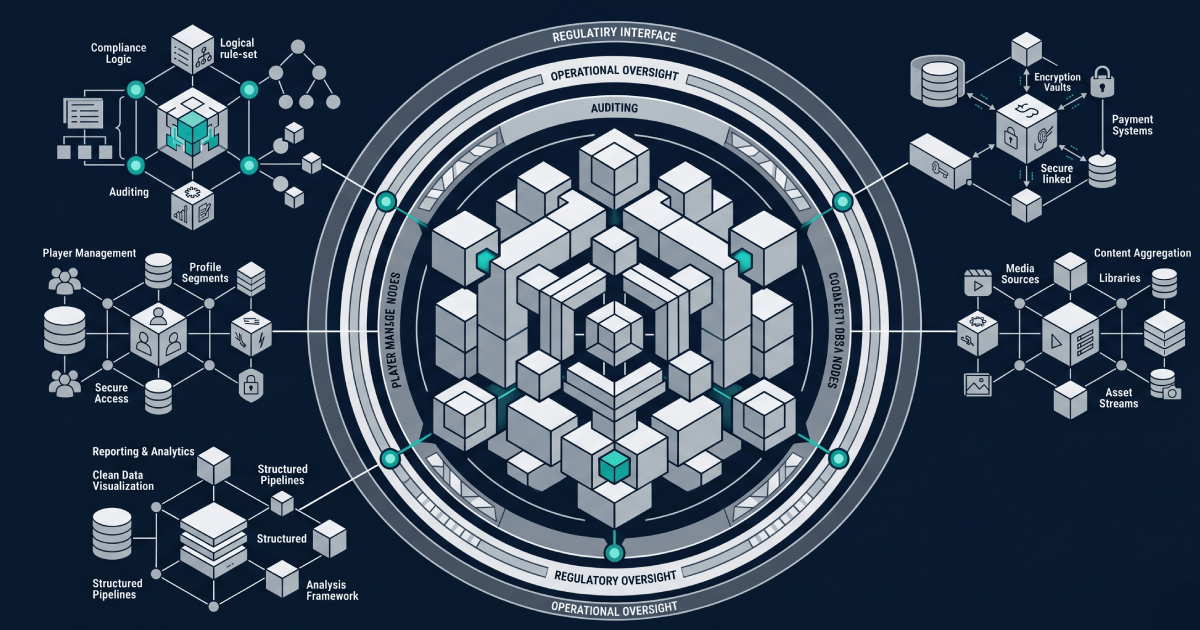
A microservices architecture lets you deploy the bingo game engine, PAM, wallet, bonusing, chat, and side-game aggregation as independent services. Each can scale independently. Peak traffic on a Saturday evening jackpot game hammers the game engine and chat services; the PAM and wallet services see steady-state load. You can scale horizontally where it matters and save infrastructure cost elsewhere. Regulatory updates to KYC flows don’t require redeploying the game engine. A bonusing feature release doesn’t touch the wallet.
The cost is operational overhead. You need mature CI/CD pipelines, container orchestration (Kubernetes, typically), distributed tracing, and an engineering team comfortable with service mesh complexity. If your platform team is under fifteen engineers, you’ll spend more time managing infrastructure than shipping features.
The modern monolith (a well-structured, modular monolith with clear bounded contexts) gives you most of the organisational benefits of microservices without the distributed systems tax. Internal modules communicate via defined interfaces. You can extract services later as scale demands it. Deployment is simpler. Debugging is simpler. For an operator launching a custom platform with a team of eight to twelve engineers, this is often the pragmatic starting point.
The hybrid approach works well in practice: start with a modular monolith, extract the game engine and chat services first (these have the most divergent scaling profiles), and evolve toward microservices as the platform and team mature. The operators who get into trouble are the ones who go full microservices on day one with a team that’s never operated a distributed system in production under regulatory scrutiny.
One non-negotiable regardless of architecture: event sourcing for all financial transactions. Every wallet movement, every bonus trigger, every wager and payout needs an immutable event log. UKGC and MGA auditors expect full transaction reconstruction. Building this in retrospectively is painful and expensive.
Your PAM is the single system that touches every other component. Get this wrong and everything downstream suffers.
A custom PAM gives you a single player view across bingo, side-games, and any casino or sportsbook verticals you operate. This sounds obvious, but operators migrating from network platforms frequently discover that their “player data” is actually fragmented across the network’s PAM, their own CRM, a third-party KYC provider, and a separate responsible gaming tool. Consolidating this into a single, authoritative player record is where real operational use comes from.
The wallet service architecture deserves particular attention. A dual-wallet model (separating real-money and bonus balances) is table stakes. But the implementation details matter. Can your wallet handle sub-second transaction processing at peak load? Can it support multi-currency across jurisdictions without currency conversion becoming a bottleneck? Can it enforce wagering requirements atomically at the point of transaction rather than in a batch reconciliation job?
For AML monitoring and responsible gaming, the wallet is your primary signal source. Real-time event streaming from wallet transactions (deposits, withdrawals, wager patterns, loss velocity) feeds directly into your AML engine and affordability checks. A custom wallet architecture lets you implement UKGC‘s tightening affordability requirements at the transaction layer rather than bolting on a third-party tool that polls a database every five minutes. The difference between real-time and near-real-time matters when your compliance team is fielding a Section 116 review.
Payment gateway integration should be abstracted behind a payment orchestration layer. You will switch PSPs. You will add new payment methods. You will enter jurisdictions where specific providers are mandated. If your wallet is tightly coupled to a single PSP’s API, each of these changes becomes a project rather than a configuration update.
Results Are Designed, Not Hoped For
Clear Objectives. Tangible Outcomes.
Well engineered software is only part of the equation. True impact comes from aligning technology with commercial intent from the outset.
We define success early, measure consistently and refine continuously to ensure every product delivers meaningful and sustained value.

Engineering the Bingo Game Engine: RNG, Game Logic, and Variant Support
The game engine is where product differentiation lives. On a network, you play 90-ball and 75-ball with the same mechanics as every other skin. With a custom engine, you define the rules.
The Random Number Generator sits at the core. For UKGC, MGA, and GGC certification, your RNG must be tested and certified by an accredited test house (BMM Testlabs, GLI, eCOGRA, NMi). This isn’t a one-time exercise. Any change to the RNG implementation, or to game logic that affects outcome probabilities, triggers re-certification. Budget for this in both time and cost: initial RNG certification typically takes six to twelve weeks, and each subsequent modification submission adds two to four weeks.
Design the RNG as a standalone, isolated service with a clean API boundary. Game logic calls the RNG for number generation; the RNG knows nothing about game state. This separation simplifies certification because changes to game variants, UI, or room management don’t touch the certified RNG module.
Game logic is where you build competitive advantage. A well-abstracted game engine supports multiple variants through configuration rather than code changes. 90-ball, 75-ball, 80-ball, speed bingo, and custom hybrid formats should all be expressible as game configuration objects: grid dimensions, win patterns, ball draw frequency, prize allocation rules. Building this as a rules engine rather than hard-coded logic means your product team can launch new variants without engineering sprints.
Jackpot systems require careful architecture. Progressive jackpots that pool across rooms or game types need a shared, consistent state service with strong consistency guarantees. An eventual consistency model is fine for displaying a chat message; it’s not fine for determining whether a player just won a £250,000 jackpot. Use a dedicated jackpot service with pessimistic locking or a serialised event model.
Multiplayer synchronisation is the other hard problem. Every player in a room must see the same ball drawn at the same time. Network latency is real. Your game server needs to manage authoritative game state and push updates via WebSocket connections, with the client treating server state as the source of truth. Auto-daub functionality (marking called numbers automatically) should be server-validated to prevent client-side manipulation.
Compliance is an architectural constraint, not a feature you add before launch.
UKGC‘s technical standards (RTS) prescribe specific requirements around game fairness, information display, self-exclusion, and financial controls. MGA‘s technical requirements overlap but diverge in areas like session limits and responsible gaming tooling. GGC has its own framework. If you’re planning multi-jurisdiction deployment, your platform needs to support jurisdiction-specific compliance configurations without forking the codebase.
Build a compliance configuration layer that controls: mandatory cool-off periods, deposit limit enforcement rules, reality check intervals, self-exclusion integration (GAMSTOP for UK), and player communication restrictions. Each jurisdiction gets a configuration profile. When the UKGC tightens affordability thresholds (which they will, repeatedly), you update the UK configuration. You don’t redeploy the platform.
Audit trails deserve more engineering attention than they typically receive. UKGC expects you to reconstruct any player’s complete activity history: every login, every deposit, every game played, every bonus awarded, every responsible gaming interaction. This isn’t a reporting requirement you solve with a data warehouse. It’s a transactional logging requirement that must be built into every service from day one. Immutable append-only logs, cryptographically verifiable if you want to be thorough.
API-first compliance architecture enables integration with third-party responsible gaming tools and regulatory reporting systems. The UKGC’s data reporting requirements will expand. Building clean APIs around player activity data now means you can connect new reporting pipelines without re-engineering your data layer under regulatory deadline pressure.
Driving Engagement: Bonusing, Chat, and Side-Game Integrations
A rigid network gives you free tickets and deposit matches. A custom bonusing engine gives you a programmable incentive layer.
The bonusing engine should be event-driven. Player actions (registration, deposit, game completion, loss thresholds, inactivity periods) emit events. The bonusing engine subscribes to these events and evaluates them against configurable rule sets. This means your CRM team can create and deploy new bonus types without engineering involvement: “Award 5 free tickets to players who played 3+ games yesterday but haven’t logged in today” should be a rule configuration, not a Jira ticket.
Wagering requirements, expiry windows, game eligibility restrictions, and maximum win caps all need to be first-class concepts in the bonus data model. Getting these wrong creates both commercial exposure and compliance risk. UKGC has been more scrutinous of bonus terms that create unfair barriers to withdrawal.
Chat is a bigger technical and operational challenge than most operators expect. Bingo chat is central to the player experience: chat games (where the chat moderator runs mini-games with small prizes) drive engagement and session length. The chat service needs to handle hundreds of concurrent users per room with sub-second message delivery via WebSockets, support automated chat games with prize fulfilment integrated into the wallet, and provide moderation tooling (profanity filters, automated flagging, manual intervention capability).
Side-game integration through a game aggregator (or direct API integrations for high-volume suppliers) should be architecturally clean. Players expect to play slots or instant wins in a side panel while their bingo game is running. This means concurrent sessions across the bingo engine and side-game providers, with a shared wallet maintaining consistency. The game aggregation layer abstracts provider-specific APIs behind a unified game launch and settlement interface. Adding a new game supplier should be a configuration and testing exercise, not an integration project.
Why Partner with Jadex for Your Bingo Platform
The gap between “we’ve built platforms” and “we’ve built bingo platforms for tier-one regulated operators” is wide. Bingo has specific engineering challenges: multiplayer synchronisation, real-time chat at scale, progressive jackpot consistency, RNG certification workflows, and the regulatory specificity of UKGC, MGA, and GGC frameworks.
Experience with operators like Rank Group and Mecca means exposure to the full complexity: multi-brand deployment, high-concurrency rooms, legacy migration from established platforms with large active player bases, and the regulatory rigour that comes with UKGC Tier 1 licensing.
If you’re scoping a build, evaluating migration from a network, or trying to modernise a legacy bingo platform, the starting point is a technical scoping engagement that maps your commercial objectives to architectural decisions and gives you a realistic cost and timeline framework. Not a pitch deck. Not a product demo. An honest engineering assessment of what it takes to get from where you are to where you need to be.
Frequently Asked Questions
Latest from our blog
Insights & Perspectives
Our insights explore the intersection of technology, commercial strategy and disciplined execution across complex digital environments.