Replacing Your Legacy iGaming Platform: A Strategic Framework
Every quarter you delay a platform decision, the cost of that decision goes up. Regulatory pressure compounds. Technical debt accrues interest. Competitors who moved earlier pull further ahead on personalization, market speed, and player experience. This article lays out a structured framework for evaluating your legacy platform, choosing between a full rebuild and targeted modernization, managing the migration of a live operation, and building a defensible TCO model that survives scrutiny from the board and your PE backers.




The UKGC‘s affordability checks, the MGA‘s updated technical compliance requirements, GGC’s changing standards for player protection: these aren’t static targets. They’re accelerating. Each regulatory update demands engineering work. On a modern, well-architected platform, that work is bounded and predictable. On a legacy system, it cascades.
You already know this. What’s harder to quantify is the opportunity cost. The sportsbook promotion your competitor launched in three days that took your team six weeks because the bonus engine is hard-coded into the monolith. The real-time AML monitoring your compliance team needs but your wallet architecture can’t support without a full batch-processing workaround. The multi-brand deployment that’s technically possible but would require duplicating infrastructure because your PAM has no concept of tenant isolation.
The risk calculus has flipped. Five years ago, the risk of migration exceeded the risk of staying put for most operators. Today, staying on a legacy platform carries regulatory risk (you can’t adapt fast enough), commercial risk (your time-to-market is measured in quarters, not sprints), and technical risk (the engineers who understand your codebase are leaving, and nobody wants to inherit a patched-together PHP monolith from 2012).
This isn’t about chasing the latest architecture trend. It’s about whether your platform can absorb the next three years of regulatory and commercial change without breaking.
Incrementally replacing specific platform components with modern services while the legacy core continues operating. The new services intercept requests that would have gone to the legacy system, gradually taking over functionality.
When it makes sense: Your core platform is functional but specific components are bottlenecks. You need to modernize the wallet for real-time capabilities, replace the PAM to support multi-tenancy, or extract the bonus engine to enable independent deployment. Your commercial and regulatory constraints don’t allow an 18-month parallel-build period.
Practical example. Extracting the wallet service from a monolithic platform. You build the new wallet as an independent microservice with its own data store, event streaming capability, and API contract. You route new transactions through the new wallet while maintaining a synchronization layer back to the legacy system. Over a defined period (typically 8 to 16 weeks for the migration phase), you shift traffic entirely to the new wallet and decommission the legacy component. The rest of the platform continues operating unchanged.
The risk. Each extraction increases the complexity of the boundary between old and new. If you extract five components over two years, you’re maintaining five integration boundaries plus the legacy core. There’s a point where the cost of maintaining these boundaries exceeds the cost of a clean rebuild. Knowing where that tipping point is, for your specific platform, is the critical strategic judgment.
Consider the pattern common to large multi-brand operators. The starting position: a monolithic backend originally built for a single brand, subsequently stretched to serve multiple brands and jurisdictions through configuration flags, conditional logic, and brand-specific code paths. Deployment risk increases with every brand. A change for Brand A requires regression testing across Brands B, C, and D. Release cycles slow to monthly at best.
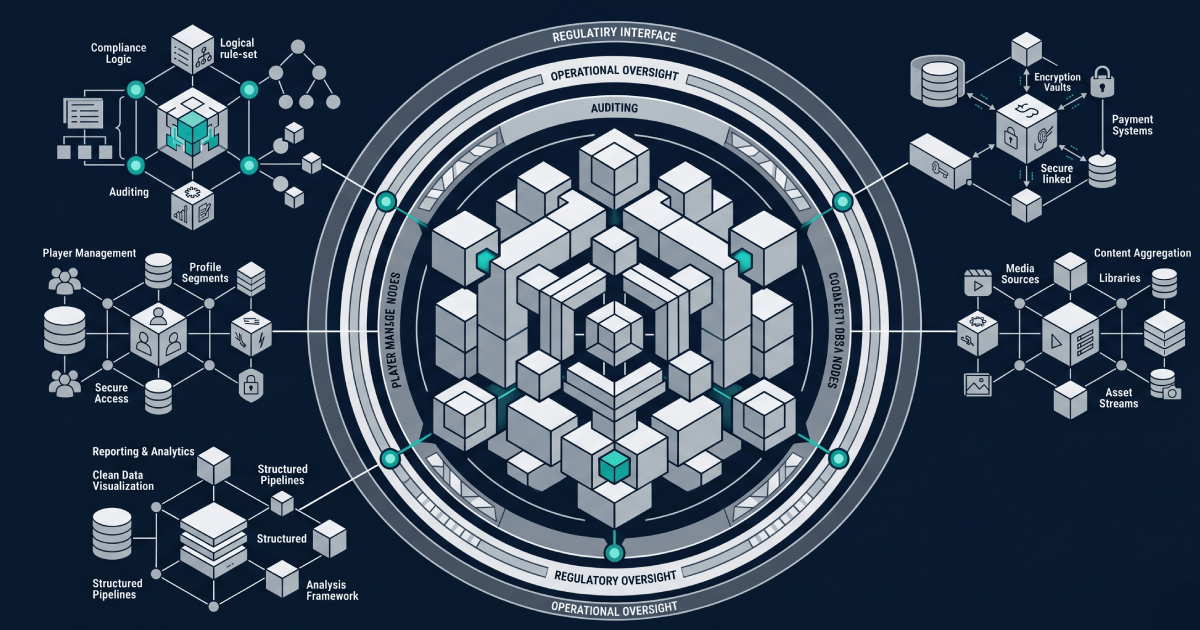
Work with operators like Rank Group and DAZN Bet has demonstrated that the path forward typically involves decomposing the monolith into domain-bounded services (player account management, wallet, bonus, content, reporting) with each service owning its data and exposing well-defined APIs. Multi-brand deployment moves from code-level branching to configuration-driven tenancy.
The results in these patterns are consistent: deployment frequency increases from monthly to multiple times per week. Jurisdiction-specific regulatory changes are implemented in days rather than weeks. New brand launches move from six-month infrastructure projects to configuration exercises measured in weeks. Engineering teams can work on independent services without cross-team coordination for every change.
The common mistakes from these projects are equally instructive. Underestimating the data migration effort (always allocate more time than you think). Attempting to modernize the architecture and redesign business logic simultaneously (do one, then the other). Insufficient investment in automated testing for the dual-running period. And the political one: losing executive sponsorship during the messy middle period when costs are high and visible benefits haven’t yet materialized.
Results Are Designed, Not Hoped For
Clear Objectives. Tangible Outcomes.
Well engineered software is only part of the equation. True impact comes from aligning technology with commercial intent from the outset.
We define success early, measure consistently and refine continuously to ensure every product delivers meaningful and sustained value.

De-Risking the Transition: Managing a Live Platform Migration
Migration risk on a live platform is real. Players are depositing, wagering, and withdrawing 24/7. Regulatory reporting must continue uninterrupted. A mishandled migration can trigger license conditions.
Data integrity is the non-negotiable. Player balances, transaction histories, bonus state, KYC records, responsible gaming interaction logs: all must migrate with zero discrepancy. This means building reconciliation tooling before you start migration, not after. Automated balance reconciliation running continuously during dual-operation periods. Transaction-level audit trails that prove regulatory compliance throughout the transition.
Migration sequencing matters. Don’t start with the wallet. Start with the lowest-risk, highest-learning component. CMS. Affiliate integration. Something that lets your team build migration muscle (tooling, runbooks, rollback procedures) without wagering real player funds. By the time you reach the wallet and PAM migration, your team has executed the process multiple times.
Canary deployments for player traffic. Route a small percentage of player sessions through the new system. Monitor error rates, latency, and player behavior. Scale up gradually. If something breaks, it breaks for 2% of players, not 100%. This requires a traffic routing layer in front of both systems, which is additional infrastructure investment but dramatically reduces blast radius.
Rollback at every stage. Every migration step must be reversible. If the new bonus engine introduces a calculation discrepancy, you need to route back to the legacy engine within minutes, not hours. Design your migration states as forward-compatible and backward-reversible. This is expensive to engineer. It is not optional.
Stakeholder communication. Your compliance team needs to know exactly what’s changing and when, because they’re the ones answering to the regulator. Your CS team needs training on both systems during dual-running. Your players should experience zero visible disruption. If they notice the migration, something has gone wrong.
Your Next Step: Building a Resilient iGaming Future
The framework outlined here, assessment, strategy selection, de-risked migration, and rigorous TCO modeling, isn’t theoretical. It reflects the actual decision process that operators Managing this transition work through.
The honest position is this: platform replacement is expensive, time-consuming, and organizationally demanding. It is also, for most operators running legacy systems under tightening regulatory frameworks, the lower-risk option compared to continued inertia. The compounding costs of legacy maintenance, the growing compliance exposure, and the widening gap in commercial capability make the status quo untenable over a three to five year horizon.
The difference between a successful migration and a failed one rarely comes down to technology choice. It comes down to the quality of the assessment, the realism of the plan, the discipline of the execution, and having a partner who has done this before and will tell you what’s actually hard rather than what you want to hear.
If you’re evaluating your platform options this quarter, start with the technical audit framework described above. Map your compliance gaps, quantify your opportunity costs, and build the TCO model. The numbers will tell you what your instincts already suspect.
Latest from our blog
Insights & Perspectives
Our insights explore the intersection of technology, commercial strategy and disciplined execution across complex digital environments.