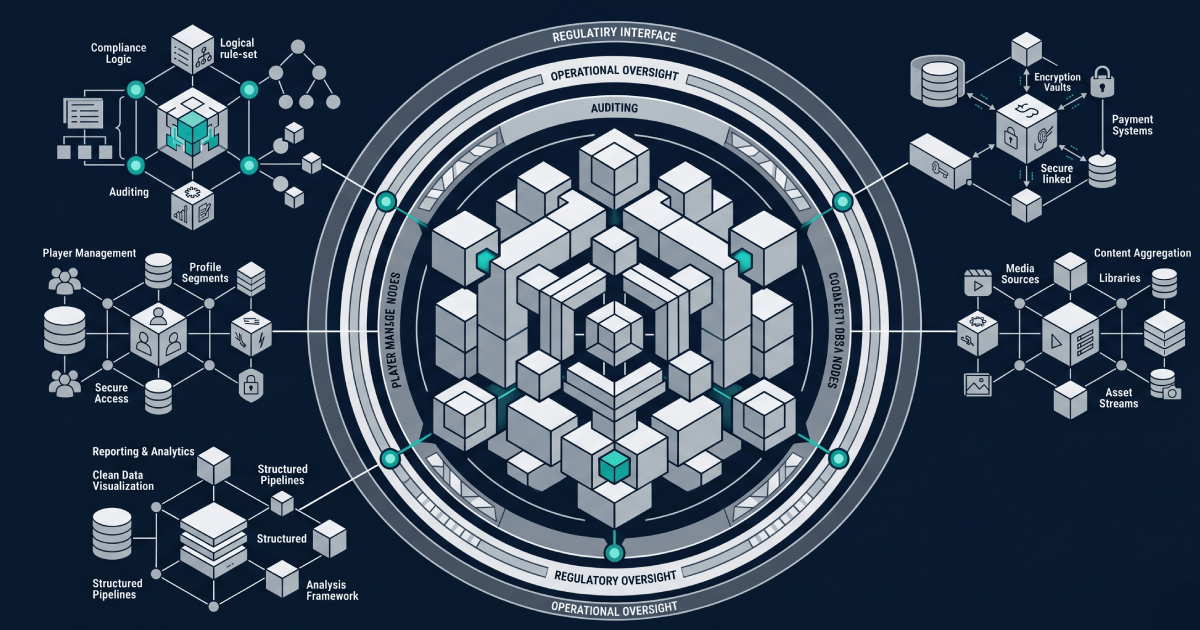
iGaming Enterprise Replatforming: A Technical Framework for CTOs
The platform that powered your operator through its growth phase three to five years ago is now the single biggest constraint on your commercial roadmap. This article provides a structured technical framework for evaluating replatforming strategies: the architectural patterns that work, the migration approaches that reduce risk, and the regulatory implications that most vendors conveniently leave out of their pitch decks.










Technical debt in iGaming platforms doesn’t accumulate gradually. It compounds in sudden, expensive bursts, typically triggered by regulatory change.
When the UKGC introduced enhanced customer interaction requirements under the 2024 licence conditions, operators running monolithic platforms built on decade-old Java stacks or tightly coupled .NET frameworks faced a painful reality. Implementing real-time affordability checks required touching transaction processing, player account management, and reporting layers simultaneously. In a well-decomposed architecture, that’s three independent workstreams. In a monolith, it’s a single, high-risk release that touches everything.
MGA‘s changing AML frameworks create the same pressure from a different angle. If your wallet service can’t emit granular transaction events in real-time, you can’t feed those events into pattern detection. You end up relying on batch processing and retrospective analysis, which satisfies the letter of compliance but not the spirit, and regulators are more focused on the spirit.
The commercial impact is equally concrete. If your content team needs a vendor release cycle to launch a new game provider integration because the aggregation layer is hard-wired into the platform core, you’re losing weeks of margin on every new supplier. If your marketing team can’t run a targeted bonus campaign without a backend ticket because the bonus engine lacks an API surface, you’re burning player acquisition spend on generic offers.
These aren’t hypothetical problems. They’re the specific conversations happening in operator boardrooms right now, and they all trace back to the same root cause: a platform architecture that was designed for a different era of regulation, a different scale of operation, and a different competitive environment.
Building the commercial case for replatforming requires more than architecture diagrams. CFOs and PE sponsors want numbers.
Start with latency. A legacy sportsbook platform running on synchronous request/response patterns with a tightly coupled database layer might handle bet placement in 800ms to 1.2 seconds under normal load. During peak events (a Champions League final, a Cheltenham Gold Cup), that degrades to 2+ seconds or worse. Every 100ms of additional latency on bet placement correlates with measurable drop-off in bet completion rates. A modern event-driven architecture with independently scaled bet processing can hold sub-200ms placement times at peak. The revenue impact of that improvement is directly calculable from your existing traffic data.
Scalability is the other side of that coin. If your platform requires manual infrastructure provisioning to handle peak traffic, you’re either over-provisioned 90% of the time (burning margin on idle compute) or under-provisioned during the events that generate disproportionate revenue. Auto-scaling against a decomposed service architecture means you scale the bet processing layer independently of the CMS, independently of the bonus engine, independently of the reporting pipeline. You pay for what you use when you use it.
Operational efficiency compounds over time. Deploying a change to a monolithic platform typically requires full regression testing across the entire application. A well-decomposed service with defined contracts can be tested and deployed independently. Teams that move from monthly release cycles to weekly or daily deployments reduce their time-to-market for feature changes by an order of magnitude. That translates directly into faster game provider integrations, faster bonus campaign launches, and faster response to regulatory requirements.
The honest caveat: replatforming requires upfront capital investment. For a mid-tier operator, a properly scoped first phase typically runs into seven figures. The payback period depends heavily on your current cost base and revenue trajectory, but the operators who have made this move consistently report that the ongoing operational savings and revenue uplift justify the investment within 18 to 24 months.
Results Are Designed, Not Hoped For
Clear Objectives. Tangible Outcomes.
Well engineered software is only part of the equation. True impact comes from aligning technology with commercial intent from the outset.
We define success early, measure consistently and refine continuously to ensure every product delivers meaningful and sustained value.

Choosing Your Strategy: Phased Migration vs. Big Bang
A big bang migration replaces the entire platform in a single cutover. It has a clean appeal on a slide deck: one migration weekend, one new platform, done.
In practice, for a regulated iGaming operator with live players, active bets, pending withdrawals, and regulatory reporting obligations, big bang is almost never the right call. The failure modes are catastrophic. If something goes wrong during cutover, your rollback path is to the old platform, which means maintaining two complete environments in parallel. The testing surface is enormous because every component changes simultaneously. And your regulators expect continuity of player protection measures throughout.
The Strangler Fig pattern is the established alternative. Named after the tropical fig that gradually envelops and replaces its host tree, this approach works by routing specific functional domains to new services while the legacy platform continues handling everything else.
A typical sequencing for an iGaming operator might look like this:
Phase 1: Extract the content management and front-end delivery layer. Move to a headless CMS with a modern front-end framework. This is relatively low risk because it doesn’t touch the transactional core, but it immediately improves page load performance and gives marketing teams direct control over content without backend dependencies.
Phase 2: Decompose the PAM and introduce a proper API layer. This is the heavy lift, because PAM touches authentication, KYC, responsible gambling controls, and regulatory reporting. But once it’s done, every subsequent phase benefits from a clean data model and consistent API contracts.
Phase 3: Wallet service extraction and modernisation. Move from a synchronous, database-locked transaction model to an event-sourced wallet with real-time event emission. This unlocks the data infrastructure required for real-time AML monitoring and fraud detection.
Phase 4: Game aggregation layer, bonus engine, and remaining platform services.
Each phase delivers independently. Each phase can be tested and validated independently. Each phase has a defined rollback path that doesn’t require reverting the entire platform. And critically, each phase can be demonstrated to your regulatory body as a controlled, documented change rather than a wholesale platform replacement.
The trade-off is timeline. A phased approach takes longer end-to-end than a big bang would take if everything went perfectly. But big bang migrations in complex regulated environments rarely go perfectly.
Data migration is where replatforming projects go wrong most often, and it’s rarely because of technical failure. It’s because nobody scoped the data properly.
A mature iGaming operator has years of player transaction history, KYC documentation, responsible gambling interaction logs, bonus activity, and regulatory reporting records. Some of this data is legally required to be retained (UKGC mandates player records for specified periods post-account closure). Some of it is commercially valuable. Some of it is both. And a surprising amount of it is contradictory, duplicated, or stored in formats that made sense to the developer who built the original system but make sense to nobody else.
The migration strategy should start with a data audit that classifies every dataset by regulatory obligation, commercial value, and migration complexity. Not everything needs to move to the new platform’s primary data store. Historical transaction records required for regulatory compliance can live in a cold storage archive with a query interface. Active player data needs full migration with validation. Bonus state in mid-flight needs careful handling to avoid either losing player entitlements or creating phantom liabilities on your balance sheet.
Data cleansing during migration is an opportunity most operators undervalue. Deduplicating player records, standardising address formats, resolving conflicting KYC statuses: this work pays dividends for years afterwards in reduced customer service overhead and improved segmentation accuracy. It’s also a prerequisite for any AI or ML capability you want to build later. Machine learning models trained on dirty data produce garbage outputs. There’s no shortcut here.
Validate everything. Run the old and new systems in parallel on a subset of live data and compare outputs. Transaction reconciliation between legacy and modern wallet systems should produce zero discrepancies before you route real player transactions through the new system.
Your Replatformed Future: Agility and Market Advantage
A completed replatforming programme doesn’t just remove constraints. It changes the velocity at which your operator can move.
New game provider integrations drop from weeks to days when your aggregation layer has a standardised adapter pattern. Regulatory changes become configuration changes rather than code changes when your compliance rules are externalised from your core business logic. Entering a new regulated jurisdiction becomes a licensing and configuration exercise rather than a platform fork.
AI and ML capabilities (personalised bonus offers, real-time churn prediction, automated responsible gambling interventions) become possible when your platform emits clean, real-time event streams from a properly architected wallet and PAM. Without that data infrastructure, every AI vendor’s pitch is fiction.
The operators who will lead their markets over the next five years are the ones making these architectural decisions now. The ones who wait will find that their technical debt compounds faster than their revenue can absorb it.
Latest from our blog
Insights & Perspectives
Our insights explore the intersection of technology, commercial strategy and disciplined execution across complex digital environments.