Gamified Prize Experience Platforms for Regulated iGaming
Most iGaming operators run bonus engines that were designed for a simpler era: deposit match, free spins, wagering requirement, withdrawal. The mechanic worked when the market was less saturated. Now, with player acquisition costs climbing past £150 in UK markets and retention rates under pressure from regulatory tightening, operators need engagement mechanics that go deeper than a 100% first-deposit match. That’s what a gamified prize experience platform actually is: a purpose-built layer that sits between your PAM, wallet services, and front-end, turning player activity into structured, compliant, measurable engagement loops tied to real rewards.
This article covers the architecture, compliance constraints, business case, and implementation reality of building one for regulated markets.









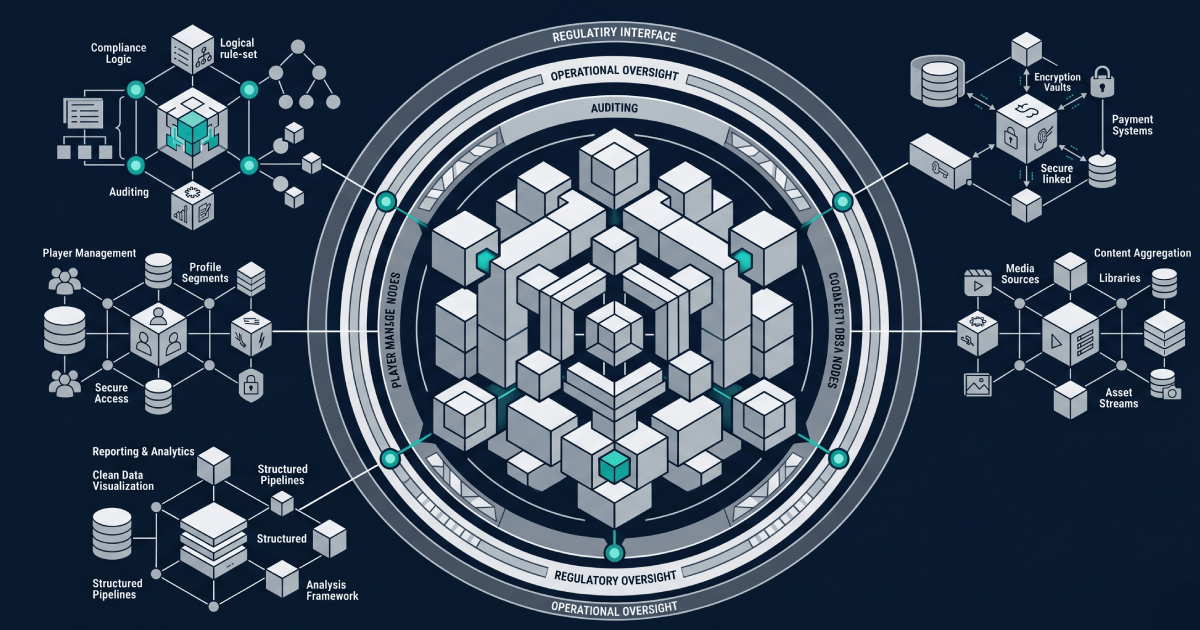
Strip away the marketing language and a gamified prize experience platform is an event-driven engine that listens to player actions, evaluates them against configurable rule sets, and triggers reward outcomes in real time. It’s not a leaderboard widget bolted onto your lobby. It’s not a third-party loyalty app making API calls to your PAM every 30 seconds.
The distinction matters because in iGaming, every reward action touches regulated territory. A “challenge” that awards bonus funds needs to interact with your bonus wallet, respect wagering requirements, honour jurisdiction-specific bonus caps, and generate the audit trail your compliance team needs for UKGC LCCP reporting. A “prize wheel” that distributes free spins needs to know the player’s deposit history, self-exclusion status, and whether they’ve hit any responsible gaming triggers before it fires.
Generic corporate gamification vendors (the ones selling “engagement platforms” to retail and fintech) don’t build for this. They don’t understand that a bonus credit isn’t a coupon code. They don’t know that a wallet debit in a regulated environment has to be idempotent, auditable, and reversible under specific conditions. They don’t build around the assumption that every player interaction might be reviewed by a regulator.
What you actually need is a gamification engine that treats your PAM as the source of truth, your wallet service as a transactional boundary, and your responsible gaming module as a hard constraint, not an optional integration.
The commercial argument for gamified prize experiences rests on three measurable outcomes: deposit frequency, session depth, and cross-product engagement.
Deposit frequency is the most direct lever. When players are working toward a challenge milestone (say, “place 10 bets on live blackjack this week to unlock a prize draw entry”), you create a reason to return that’s independent of their natural betting cycle. This isn’t theoretical. Operators who’ve implemented structured challenge mechanics report measurable uplift in deposits-per-player-per-month within targeted segments.
Session depth matters because it drives GGR. A player who stays 20 minutes longer per session because they’re two tasks away from completing a challenge generates more betting volume. The key is that the engagement mechanic itself isn’t costing you bonus margin on every incremental minute. The cost of the reward is fixed or capped; the revenue from extended play scales.
Cross-product engagement is where the real compounding happens. If your sportsbook and casino run on the same PAM but your bonus engines are siloed (common in white-label setups), you’re leaving money on the table. A gamification layer that spans both products can create challenges like “bet on three football matches and play 50 spins to unlock a reward.” That’s genuine cross-sell driven by a game mechanic rather than a banner ad.
The metric that ties it together is player lifetime value. Gamification doesn’t change the house edge or the odds. It changes how often, how long, and across how many products a player engages. When you model that against the cost of the gamification layer (infrastructure, content operations, prize liability), you get a real ROI number, not a hand-wavy engagement score.
Results Are Designed, Not Hoped For
Clear Objectives. Tangible Outcomes.
Well engineered software is only part of the equation. True impact comes from aligning technology with commercial intent from the outset.
We define success early, measure consistently and refine continuously to ensure every product delivers meaningful and sustained value.

Prize and Bonus Strategy: Beyond Free Spins
Free spins are the default reward in iGaming gamification because they’re cheap to issue, easy to understand, and already supported by every bonus engine. They’re also becoming invisible to players. When every operator offers free spins for every action, the mechanic stops driving behaviour.
Effective prize strategies tier rewards by effort and player value. Low-effort challenges (daily logins, first bet of the day) get low-friction rewards: small bonus credits, free bet tokens. Medium-effort challenges (multi-step, multi-day) unlock higher-value rewards: enhanced odds, cashback on losses, or entry into exclusive prize draws. High-effort challenges (monthly leaderboard placement, sustained activity targets) can justify tangible prizes: event tickets, electronics, experience packages.
The psychology here is straightforward: variable reward schedules drive stronger engagement than fixed ones. A mix of guaranteed small rewards and probabilistic larger rewards keeps players engaged across the effort spectrum. But every prize type has operational implications. Tangible prizes require fulfilment logistics and potentially different tax treatment. Prize draws in certain jurisdictions have specific regulatory requirements around transparency and fairness.
One pattern that works well: let players choose between reward types at certain milestones. “Take the £5 bonus credit now, or bank your progress toward the monthly prize draw.” This gives players agency and generates useful data about what your segments actually value.
Partner with Jadex to Engineer Your Player Engagement Future
Building a gamified prize experience platform for regulated iGaming requires deep knowledge of PAM architecture, wallet services, bonus engines, and the regulatory frameworks that constrain every design decision. This is work that’s been done at the tier-one level, for operators like Rank Group and Mecca, where compliance isn’t a checkbox and platform quality directly affects millions of players.
If you’re evaluating how to add a gamification layer to your existing platform, or you’re mid-migration and want to build engagement mechanics into your new architecture from day one, the right starting point is a technical audit of your current stack against the requirements outlined above. That’s a conversation worth having before you commit to a vendor, a build timeline, or a budget.
Get in touch to scope the work.
Latest from our blog
Insights & Perspectives
Our insights explore the intersection of technology, commercial strategy and disciplined execution across complex digital environments.