Choosing a Bingo Software Provider: A CTO’s Technical Comparison
Most bingo platform decisions get made on a three-year horizon but haunt an operator for a decade. The provider you choose determines your regulatory agility, your ability to differentiate player experience, your data ownership, and your total cost of change when the next UKGC licence condition lands. This article provides a technical framework for evaluating the real options, from the dominant network providers through white-label constraints to the architectural decisions that matter if you’re building or migrating to a custom platform.





The bingo vertical gets treated as a commodity play by too many operators. Pick a white-label, launch a skin, run some promotions, move on. The problem surfaces 18 to 36 months later: you’re paying revenue share on every depositing player, you can’t modify the wallet service to support real-time affordability checks the UKGC now expects, and your “unique” bingo site looks identical to 40 others on the same network.
Technical debt in bingo platforms is particularly insidious because it accumulates at the intersection of game engine, player account management, and compliance tooling. A monolithic backend that was acceptable under 2018 regulatory conditions becomes a liability when the MGA tightens AML reporting requirements or the UKGC mandates new player interaction triggers. The cost of retrofitting compliance into a platform you don’t control is always higher than building it in from the start.
For iGaming operators evaluating platform options, the decision tree has three branches: stay on an existing white-label and accept its constraints, migrate to a different vendor’s platform, or invest in a custom build that you own. Each path has real costs. The mistake is treating the first option as “free” because there’s no upfront capital expenditure. Revenue share at 15 to 25 percent of net gaming revenue, compounded across a growing player base, typically exceeds the amortised cost of a custom build within three years.
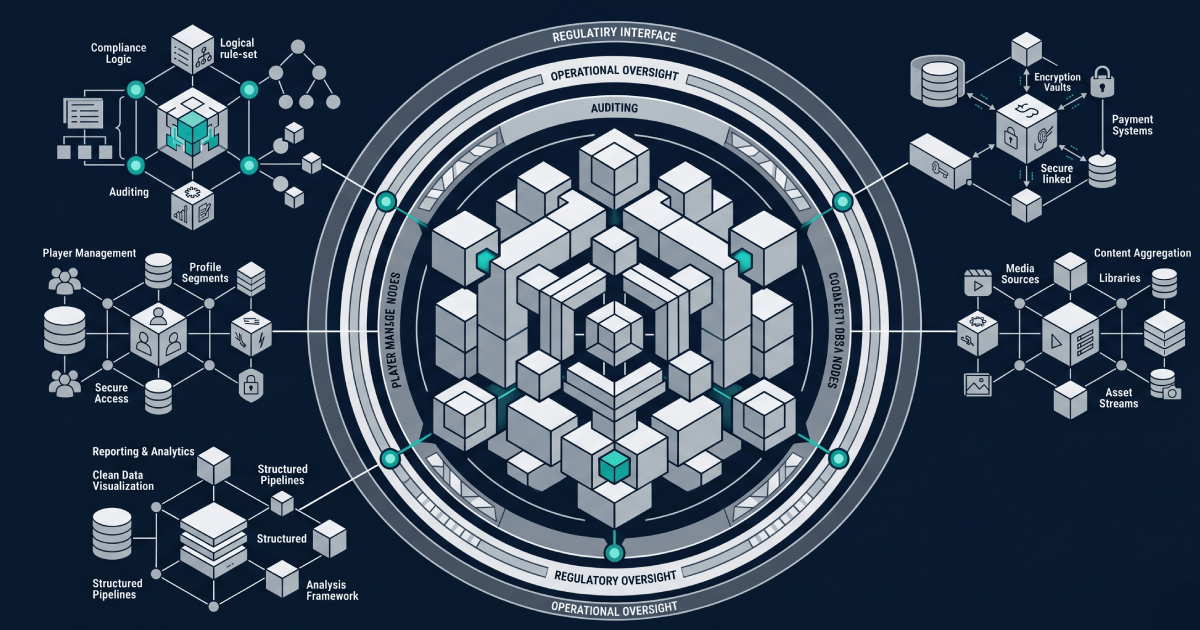
A bingo software provider delivers the full operational stack, not just the game. Understanding what’s actually in that stack matters when you’re evaluating what you can replace, what you’re locked into, and where the integration boundaries sit.
The core game engine handles random number generation (certified to the relevant jurisdiction’s standards), ticket purchasing, number calling mechanics, pattern matching, and prize distribution. This is the component most operators assume they’re buying. It’s the smallest piece of the puzzle.
Around that engine sits the real complexity: the player account management (PAM) system handling registration, KYC integration, session management, and interaction history. The wallet service managing deposits, withdrawals, bonus funds, and the accounting ledger that regulators audit. The back-office management layer providing operator controls for game scheduling, prize configuration, promotion management, and reporting. Payment processing integrations across card, e-wallet, and open banking rails. The chat system that in bingo is revenue-critical, not a nice-to-have, because community drives retention. The frontend presentation layer covering lobby, game rooms, purchase flows, and responsive mobile delivery.
When you select a B2B bingo partner, you’re adopting their opinion on how all of these components should interact. Their data model becomes your data model. Their API boundaries become your integration constraints. Their release cycle becomes your feature velocity. That’s the real evaluation.
The build versus buy decision is the structural choice that shapes everything downstream.
White-label solutions deliver speed to market. You can launch a branded bingo site in weeks, with a proven game engine, an existing player network, and regulatory certification already in place. For operators testing a market hypothesis or entering a new jurisdiction quickly, this has genuine value. The cost is paid later: revenue share that scales linearly with your success, a feature roadmap you don’t control, limited ability to create bespoke content or unique brand identity, and a player experience that’s functionally identical to your competitors on the same network.
The “similar sites” problem in bingo is well known. Operators on the same white-label platform share game schedules, prize pools, chat hosts, and promotion structures. Players notice. They sign up across multiple skins, chase welcome offers, and show no loyalty to any individual brand. Your acquisition cost goes up, your lifetime value stays flat, and your only lever is outspending competitors on CPA.
Custom platform development inverts this equation. You own the code, the data, and the roadmap. You can iterate on player experience without submitting change requests. You can build compliance tooling that matches your specific regulatory obligations rather than relying on a vendor’s lowest-common-denominator approach. You can integrate any game aggregator, any payment provider, any analytics stack.
The trade-off is real: higher upfront investment, longer initial time to market, and the need for an engineering team (internal or contracted) that understands the domain. A custom bingo platform build, scoped properly, typically ranges from £1.5M to £4M depending on jurisdiction count, game complexity, and integration requirements. That number shocks operators who’ve only ever seen white-label pricing. But model it against five years of 20 percent revenue share on a growing business and the arithmetic shifts decisively.
Compliance is an engineering problem. Treating it as a checkbox exercise, or outsourcing it entirely to your platform vendor, creates risk that surfaces at audit time.
UKGC, MGA, and GGC frameworks share common principles but diverge on implementation specifics. The UKGC’s changing stance on affordability checks, for instance, requires real-time data aggregation across deposit velocity, loss thresholds, and session duration, combined with configurable interaction triggers. A white-label platform might implement a generic version of this, tuned to the median operator’s risk appetite. If your compliance team needs tighter thresholds, custom messaging, or integration with third-party affordability data providers, you’re filing change requests and waiting.
AML monitoring in bingo has specific characteristics. The transaction values are lower than casino or sports betting, but the volume is higher and the social features (chat tipping, community jackpots) create transaction patterns that generic AML tools can misclassify. Purpose-built transaction monitoring that understands bingo-specific patterns reduces false positive rates and keeps your compliance team focused on genuine risk.
Responsible gambling tooling is where platform architecture matters most acutely. Session time limits, deposit limits, reality checks, cool-off periods, and self-exclusion all need to work reliably under load, across devices, and without race conditions. A player setting a deposit limit on mobile while simultaneously depositing on desktop is an edge case that exposes architectural shortcuts. If your wallet and PAM are tightly coupled in a monolith, this is hard to get right. With proper service boundaries and event-driven state management, it’s a solved problem.
The operators who handle regulatory change most efficiently are the ones who control their compliance architecture. When the next licence condition lands, they deploy configuration changes in days, not months.
Results Are Designed, Not Hoped For
Clear Objectives. Tangible Outcomes.
Well engineered software is only part of the equation. True impact comes from aligning technology with commercial intent from the outset.
We define success early, measure consistently and refine continuously to ensure every product delivers meaningful and sustained value.

Choosing a Partner: Provider vs. Engineering Firm
The selection question isn’t “which provider has the best feature list.” It’s “what kind of relationship do we need?”
A product vendor gives you a platform. You configure it, brand it, and operate it within its boundaries. This works if your competitive advantage lies elsewhere, in brand, marketing, or market access, and you’re content to run a bingo product that’s architecturally identical to your competitors.
An engineering partner builds your platform. You own it. The relationship is measured in architectural decisions, code quality, regulatory expertise, and the ability to transfer knowledge to your internal team. The criteria for selecting this partner look different from a vendor evaluation:
Regulated market experience. Has the team built and operated platforms under UKGC, MGA, or GGC licence conditions? Do they understand the engineering implications of those frameworks, not just the compliance requirements? Building for regulated iGaming is different from general SaaS development. Session management, RNG certification, transaction integrity, and audit logging impose constraints that teams without domain experience underestimate.
Tier-one operator track record. Work with operators like Rank Group or Mecca Bingo reveals the complexity of operating at scale in regulated markets. These engagements involve multi-brand deployment, legacy migration (often while keeping live operations running), and regulatory change delivered under commercial pressure. Ask for references at this level.
Architecture over technology. Be wary of partners who lead with their technology stack rather than their architectural approach. The right framework or cloud provider matters less than the right service boundaries, the right data model, and the right approach to testing and deployment. A well-architected platform on mature, boring technology will outperform a poorly-architected one on the latest stack, every time.
Knowledge transfer model. If the engagement ends and you can’t maintain the platform without calling your partner, they built a dependency, not a product. Evaluate how code ownership, documentation, and team ramp-up are structured from day one.
Building for Market Leadership, Not Just Participation
Network bingo platforms are designed for participation. They lower the barrier to entry, provide shared liquidity, and let operators launch quickly. That model works for a certain profile of operator, and there’s no shame in choosing it deliberately.
But if your strategic intent is market leadership (differentiated player experience, regulatory agility, data-driven personalisation, and long-term margin improvement), you need to own your platform. The operators who have made this investment, including tier-one brands like Mecca Bingo, operate on a fundamentally different competitive footing. They set the pace on product innovation. They respond to regulatory change on their own timeline. They build player experiences that can’t be replicated by launching another skin on the same network.
The platform decision is a capital allocation question that deserves capital allocation rigour. Model the five-year total cost of ownership across your realistic options. Include revenue share, change request costs, migration risk, and the opportunity cost of features you can’t build. Then make the decision with open eyes.
The bingo market rewards operators who control their technology. Everything else is rent.
Frequently Asked Questions
Latest from our blog
Insights & Perspectives
Our insights explore the intersection of technology, commercial strategy and disciplined execution across complex digital environments.