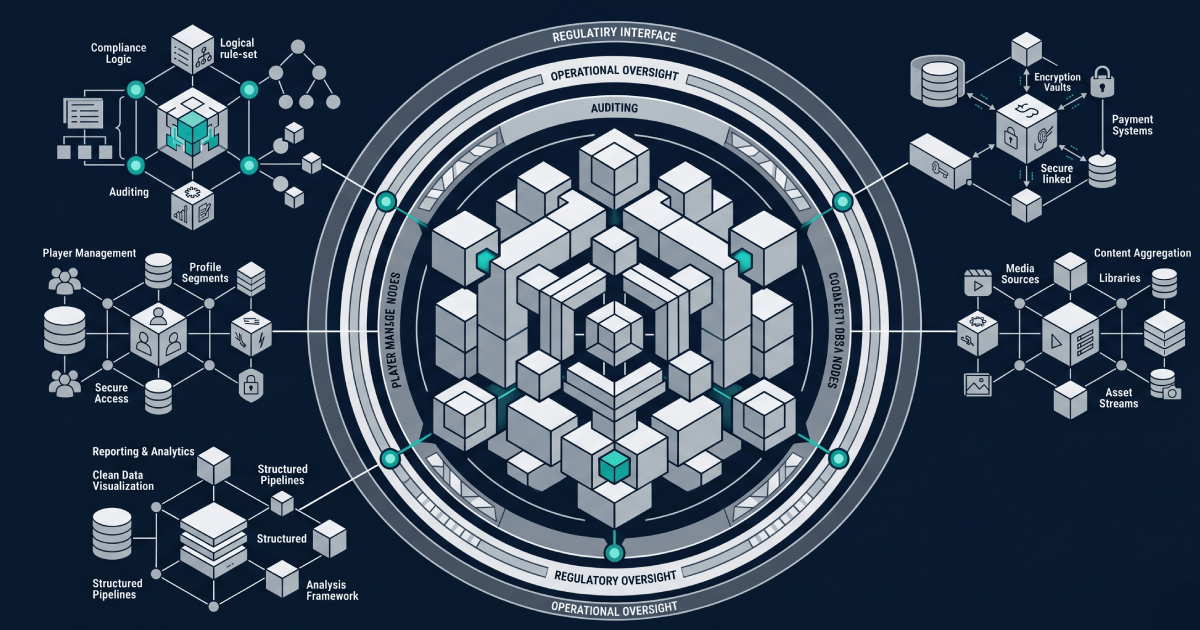
MGA Platform Compliance: Key Architectural & Regulatory Considerations
Every operator who has been through an MGA licence renewal or a UKGC compliance assessment knows the same thing: the cost of retrofitting compliance into a platform that wasn’t designed for it dwarfs the cost of building it in from the start. Yet most platform decisions are still made on commercial or feature grounds, with regulatory architecture treated as a downstream concern. This piece breaks down the specific architectural patterns, regulatory requirements, and evaluation frameworks that determine whether a platform can absorb tightening MGA and UKGC requirements without spiralling into technical debt.










Delegated authority models introduce a specific kind of regulatory exposure that generic platform architectures handle poorly. When an operator holds an MGA licence, the regulator has delegated certain powers, including the authority to offer games, process transactions, and manage player funds, under strict conditions. The operator bears direct responsibility for demonstrating ongoing compliance. The MGA doesn’t care whether your platform vendor’s roadmap includes the reporting feature you need by Q3. If you can’t produce accurate bordereaux data, if your underwriting guidelines aren’t enforced programmatically, or if your producer management lacks proper licence tracking, the exposure sits with you.
The MGA compliance challenges that catch operators out are rarely the obvious ones. Licence condition adherence, AML obligations, responsible gambling tooling: everyone knows these exist. The problems surface in the gaps between systems. A wallet service that can’t produce transaction-level audit data in the format the MGA expects. A game aggregator integration that doesn’t pass through the metadata required for regulatory reporting. A producer onboarding flow that stores licence expiry dates in a spreadsheet rather than triggering automated alerts.
These aren’t hypothetical scenarios. They’re the kinds of issues that surface during regulatory audits and turn what should be a routine review into an enforcement action.
The regulatory requirements imposed by the MGA are prescriptive about data retention, transaction traceability, and player protection mechanisms. Bordereaux reporting alone requires structured, accurate, and timely submission of detailed financial data across multiple dimensions. If your platform treats this as a reporting layer bolted onto a data warehouse, you’ve already introduced latency and reconciliation risk. If it’s baked into the transactional architecture, you can generate it from the same source of truth that processes the bets.
The Malta Gaming Authority and the UK Gambling Commission share some philosophical ground but differ materially in their technical expectations.
The MGA‘s regulatory oversight focuses heavily on financial controls, AML obligations, and player fund segregation. Their technical requirements around reporting formats, submission frequencies, and data retention are specified in licence conditions and subsidiary legislation. The MGA has also been tightening its approach to platform architecture review as part of the licensing process, asking more detailed questions about system design, hosting arrangements, and disaster recovery.
The UKGC operates with a different enforcement posture. Their focus on social responsibility, customer interaction, and affordability checks has driven a set of technical requirements that are distinct from the MGA’s. The UKGC’s expectations around single customer view, real-time interaction monitoring, and affordability assessment require architectural capabilities that many platforms built primarily for MGA compliance don’t support natively. The reverse is also true: a platform built for UKGC compliance may lack the bordereaux and financial reporting depth that the MGA demands.
The Gibraltar Gambling Commissioner (GGC) adds a third flavour, with its own expectations around system testing, change management processes, and technical standards.
For operators holding licences across multiple jurisdictions, the platform architecture must support jurisdiction-specific compliance configurations without forking the codebase. This means compliance rules, reporting templates, and player protection mechanisms should be parameterised by jurisdiction, ideally driven by configuration rather than code changes. A monolithic backend that embeds jurisdiction-specific logic in application code becomes a maintenance burden that grows with every new market entry.
Multi-jurisdiction deployment is where microservices or well-bounded modular architectures earn their complexity budget. A jurisdiction-aware compliance service that consumes events from the core platform and applies jurisdiction-specific rules is substantially easier to extend than a monolith that requires a code release every time a regulator changes a threshold.
Workflow automation applied to compliance tasks reduces error rates and creates auditable process records. Licence renewal workflows, SAR (Suspicious Activity Report) preparation, and responsible gambling escalation processes all benefit from automated task assignment, deadline tracking, and status visibility. The value isn’t efficiency alone. It’s the audit trail that workflow automation generates: evidence that the right process was followed, by the right person, within the required timeframe.
AI and machine learning in compliance is an area where vendor promises regularly outrun platform reality. Fraud detection and AML monitoring are legitimate ML applications, but they require specific data infrastructure prerequisites that most operator platforms don’t have in place. Real-time feature stores, labelled training data from historical SARs and fraud cases, model versioning, and explainability tooling are all prerequisites. Without them, you’re running rules engines with a machine learning label.
The honest assessment: most operators at the MGA tier are better served by well-tuned rules engines with manual review workflows than by ML models they can’t explain to a regulator. The MGA (and especially the UKGC) will ask how your AML decisioning works. “A neural network flagged it” is not an acceptable answer. If you can’t explain the decision logic, you can’t demonstrate compliance.
API-first architecture is a genuine enabler here. If your compliance services expose clean APIs, you can integrate third-party AML monitoring, identity verification, and risk scoring services without deep platform surgery. This also allows you to swap providers when contract terms change or when a vendor’s detection quality degrades, something that happens more often than most operators plan for.
Results Are Designed, Not Hoped For
Clear Objectives. Tangible Outcomes.
Well engineered software is only part of the equation. True impact comes from aligning technology with commercial intent from the outset.
We define success early, measure consistently and refine continuously to ensure every product delivers meaningful and sustained value.

Implementation and Migration: Maintaining Compliance Under Pressure
Migrating from a legacy system while maintaining continuous compliance is the hardest problem in platform engineering for regulated operators. The constraints are unforgiving: you cannot have a period where transaction records are incomplete, where AML monitoring has gaps, or where player protection mechanisms are degraded.
Data migration deserves particular attention. Player records, transaction histories, and compliance event logs must transfer completely and accurately. Reconciliation between source and target systems should be automated and verified before cutover. Run parallel systems for a defined period, with automated reconciliation checks that compare transaction outcomes between old and new platforms. This is expensive, but the alternative is worse.
User access control in the new platform must replicate or improve upon the legacy system’s permission model from day one. MGA licence conditions require that access to player data and financial systems is restricted to authorised personnel. A migration that temporarily grants broader access to help data loading is a compliance violation, even if it lasts only hours.
The vendor partnership during implementation matters more than during the sales process. Evaluate the vendor’s implementation team separately from their sales team. Ask about the team’s experience with MGA-licensed operators specifically. Ask for references from operators who completed migrations, not greenfield deployments. Migrations are harder, and a vendor’s migration competency is a different capability than their platform-building competency.
Future-Proofing Your Compliance Strategy
The trajectory is clear: the MGA, UKGC, and GGC are all moving toward more technology-driven supervision. The MGA’s ongoing investment in its regulatory technology capability, combined with tightening requirements around real-time reporting and proactive player protection, signals that the bar for platform compliance will continue to rise.
Operators who treat their current platform as “compliant enough” are accumulating regulatory technical debt. Every quarter that passes without adapting to new requirements adds to the cost of the eventual reckoning. The operators who manage this well are the ones who view compliance architecture as a continuous investment rather than a project with an end date.
The practical implications for platform decisions being made today: favour architectures that support configuration-driven compliance rules over hard-coded ones. Favour event-driven data flows over batch processing. Favour API-first designs that allow component substitution. Favour vendors who demonstrate regulatory awareness at the engineering layer, not just in their marketing materials.
The decisions you make about platform architecture this quarter will determine your compliance cost structure for the next three to five years. The regulatory environment will not become simpler.
Latest from our blog
Insights & Perspectives
Our insights explore the intersection of technology, commercial strategy and disciplined execution across complex digital environments.