Integrating Responsible Gambling Tools: A Platform Architecture Guide for Operators
Most operators treat responsible gambling tooling as a compliance checkbox bolted onto an existing platform. That works until a regulator raises the bar, and then the real cost becomes visible: rushed engineering sprints, brittle integrations, and audit findings that expose architectural gaps you knew were there but never prioritised. This guide breaks down the platform architecture decisions behind effective RG integration, from wallet service design and event-driven processing to the honest realities of ML-based player risk models, cross-platform self-exclusion, and the business case that justifies the investment.










The commercial calculation around player protection has shifted. Five years ago, the primary risk was a regulatory fine. Today, the risk surface includes licence conditions reviews, personal management licence sanctions, loss of banking relationships, and the reputational damage that follows a publicised failing. The UKGC‘s enforcement actions against operators for social responsibility failures have grown both in frequency and severity. The cost of a reactive posture now exceeds the cost of building it properly.
This changes the strategic framing. Player protection is an operational capability that directly affects licence retention, payment processing relationships, and player lifetime value. Operators running proactive intervention systems report lower rates of player self-exclusion, because they catch deteriorating behaviour earlier and offer friction at the right moment rather than waiting for a player to hit a wall.
The shift from player-initiated tools (a deposit limit the player sets themselves) to operator-driven intervention (the platform detects a change in behaviour and acts) is not optional in UKGC-regulated markets. LCCP Social Responsibility Code 3.4.3 requires licensees to identify customers who may be experiencing or at risk of harm, and to interact with them in a way that minimises harm. That’s a proactive obligation. If your platform architecture only supports reactive tools, you’re already behind the regulatory expectation.
The foundational toolkit is well understood: self-exclusion, deposit limits, loss limits, wager limits, session time limits, and reality checks. The question isn’t whether to offer them. It’s whether your platform can enforce them reliably across every product vertical, in real time, without edge cases that let transactions slip through.
Start with the wallet. If your wallet service is monolithic, processing deposits, withdrawals, wager settlement, and bonus allocation in a single tightly coupled service, you have a problem. Real-time limit enforcement requires the wallet to evaluate every transaction against the player’s current limit state before committing it. In a monolithic wallet, adding this check introduces latency across all transaction types and creates a single point of failure for limit enforcement logic. A player depositing £50 against a £100 daily deposit limit needs that limit checked and the remaining allowance decremented atomically. If the limit state is stored in a separate service with eventual consistency, you’ll get race conditions: two rapid deposits that individually pass the check but collectively exceed the limit.
Session time limits expose a different architectural gap. If your platform relies on front-end timers (JavaScript countdowns in the browser or app), the enforcement is trivially circumvented by opening a new browser tab or clearing session storage. Server-side session tracking, with the session state maintained in the PAM (Player Account Management) system, is the only reliable approach. This means the PAM needs to publish session events (start, heartbeat, end) and a downstream service needs to evaluate elapsed time against configured limits.
Loss limits are architecturally the most complex because they require aggregation across wager outcomes, not just deposits. A player who deposits £100, wagers it, wins £200, then loses £200 has a net loss of £100 despite no additional deposit. Enforcing a net loss limit means your platform needs a real-time aggregation of settled wager outcomes per player, per configurable time window (daily, weekly, monthly). If your sportsbook, casino, and live casino verticals settle wagers through different services with different data models, you need a unified event stream to calculate net loss consistently.
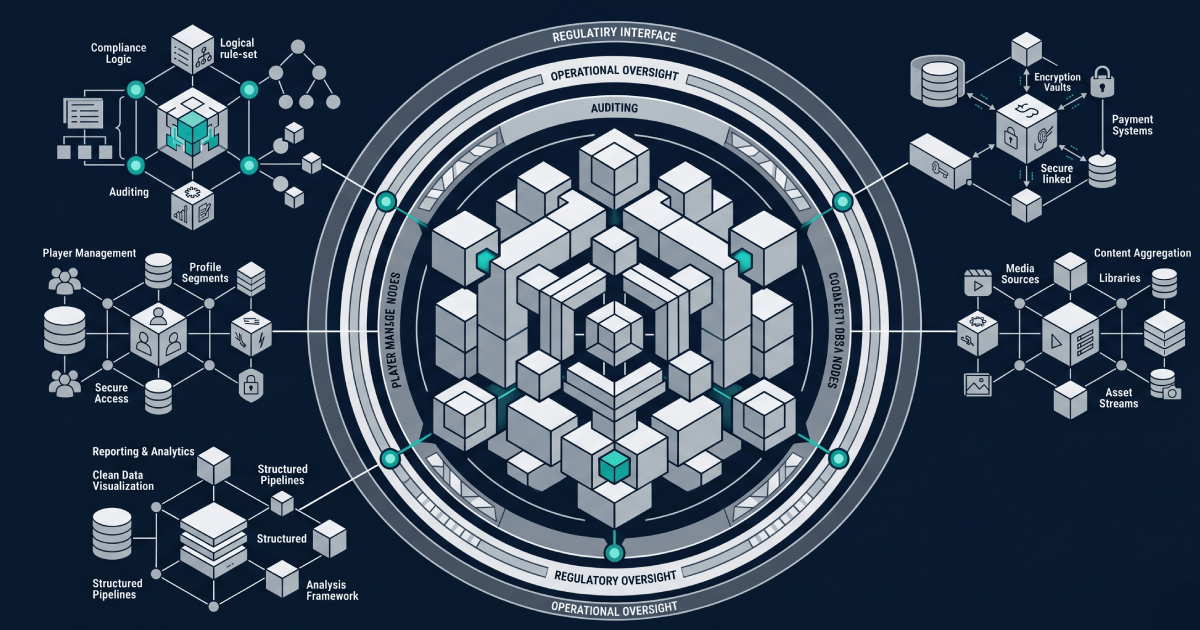
The pattern that solves most of these problems is event-driven architecture with a centralised player state service. Every financially relevant action (deposit, wager placed, wager settled, withdrawal) emits an event. A dedicated RG service consumes these events, maintains the player’s limit state, and can block or flag transactions that would breach a configured limit. This decouples the limit enforcement logic from the wallet and settlement services, which reduces blast radius and makes the RG logic independently testable.
Results Are Designed, Not Hoped For
Clear Objectives. Tangible Outcomes.
Well engineered software is only part of the equation. True impact comes from aligning technology with commercial intent from the outset.
We define success early, measure consistently and refine continuously to ensure every product delivers meaningful and sustained value.

Using AI & ML for Proactive Intervention
Rules-based alerts get you to a baseline. “Flag any player who deposits more than £1,000 in 24 hours” is a rule. It catches some at-risk behaviour. It also generates a flood of false positives (high-value recreational players who deposit large amounts routinely) and misses players whose harm indicators are subtler: a gradual increase in session frequency, shortening intervals between deposits, or a shift from slots to higher-volatility products.
ML models move beyond static thresholds by learning patterns from historical data. The goal is to identify players whose behaviour is changing in ways that correlate with subsequent harm outcomes (self-exclusion, complaints, chargebacks, account closures). This is a classification problem: given a player’s recent behavioural features, what is the probability that this player will experience a harm outcome within the next N days?
The honest reality: most operators’ data infrastructure cannot support this out of the box. ML models need features computed from behavioural data, and those features need to be computed consistently across training and inference. If your data pipeline for training is a nightly batch job pulling from a data warehouse, but your inference pipeline needs to score players in near-real-time, you have a training/serving skew problem. The model learns from features computed one way and scores using features computed a different way, which degrades accuracy.
The prerequisite is a feature store, or at minimum, a shared feature computation layer that both the training pipeline and the serving pipeline use. Without this, you’ll spend more time debugging data inconsistencies than improving model performance.
Don’t let vendors convince you that their “AI-powered” solution will work on day one. Ask them three questions: What features does the model use? Where does the feature computation happen? How do they handle training/serving consistency? If they can’t answer clearly, the product isn’t production-grade.
GAMSTOP in the UK and Spelpaus in Sweden are national self-exclusion registers. Every licensed operator must check registrations at account creation and login, and must not allow excluded players to gamble.
The technical challenge is identity matching. GAMSTOP provides an API that accepts player details (name, date of birth, postcode, email) and returns a match/no-match response. The complication is fuzzy matching: players may register on GAMSTOP with slightly different details than they use on your platform. Variant spellings, maiden names, transposed digits in dates of birth. The GAMSTOP API handles some of this fuzziness server-side, but operators are responsible for submitting accurate data and handling edge cases where a “possible match” is returned.
Integration architecture for GAMSTOP should be synchronous at registration (block account creation if a match is found) and periodic for existing accounts (batch checking the active player base against the register on a scheduled cadence, typically daily). The batch check catches players who self-exclude after having already created an account on your platform.
The data exchange must be encrypted in transit (TLS 1.2+) and the operator must not store GAMSTOP registration data beyond what’s needed for the check. This is both a GDPR requirement and a condition of the GAMSTOP API agreement.
Multi-jurisdictional operators face a compounding problem: each jurisdiction has its own self-exclusion scheme with its own API, data format, and matching rules. If you operate across UK, Sweden, and multiple US states, you need an abstraction layer that normalises the interface to these different registries. Without this, you end up with bespoke integration code per jurisdiction, which becomes a maintenance burden as new markets come online.
UKGC‘s LCCP Social Responsibility provisions are the most prescriptive. Code 3.4.1 requires operators to implement tools for customers to manage their gambling. Code 3.4.3 requires operators to identify and interact with at-risk customers. The engineering implications: your platform must log every player interaction, every limit change, every self-exclusion event, and every operator-initiated intervention with timestamps and audit trails. These logs must be retainable and retrievable for regulatory review.
MGA‘s Player Protection Directive (2018) has similar requirements but allows more flexibility in implementation. The MGA is less prescriptive about specific tool implementations and more focused on outcomes. However, the direction of travel is convergence with UKGC standards, particularly for tier-one operators seeking dual licensing.
GGC (Gibraltar) requirements sit between the two. Gibraltar-licensed operators serving UK customers must comply with UKGC requirements for those customers regardless.
The practical engineering requirement across all three: you need a complete audit log of all RG-related events, stored immutably, queryable by player ID and date range, and retainable for the period specified by each regulator (typically 5+ years). If your current logging infrastructure is application-level log files or a basic ELK stack, you likely need a dedicated audit event store with appropriate retention policies and access controls.
Automated intervention triggers are another engineering requirement. If your ML model or rules engine identifies a player as at-risk, the regulator expects an interaction to follow. That interaction needs to be logged, the player’s response needs to be captured, and the outcome needs to be recorded. This is a workflow engine problem: trigger event → create case → assign action → record outcome → close case. Build this as a discrete service rather than embedding it in the CRM, because the regulatory audit trail requirements are different from marketing communication logs.
Building the Business Case: The ROI of Advanced RG Technology
The fines-avoidance argument is necessary but insufficient to secure platform engineering budget. A stronger business case models three additional factors.
Player lifetime value through sustainable play. Players who receive timely, appropriate interventions play for longer. A player who might have self-excluded after a harmful episode may instead reduce their activity to a sustainable level if the platform intervenes early. The LTV difference between a self-excluded player (zero future revenue) and a player who moderates their behaviour is significant. Model this by analysing the revenue trajectory of players who self-exclude versus players who were flagged and received intervention but continued playing at reduced levels.
Operational cost reduction. Each problem gambling complaint that reaches your customer service team costs money to handle: agent time, compliance review time, potential remediation. Proactive intervention reduces the volume of these escalations. Track the cost-per-escalation and the escalation rate before and after deploying improved RG tooling.
Regulatory capital. Operators with demonstrably strong RG programmes have better relationships with regulators. This translates into faster licence approvals in new jurisdictions, less burdensome compliance reviews, and more favourable outcomes when issues do arise. This is harder to quantify but is a real factor in multi-market expansion strategy.
Build the model over a 3-to-5-year horizon. Year one is investment-heavy: platform engineering, data infrastructure, model development, and team training. Years two through five show the return through reduced escalations, improved retention, and avoided regulatory action. The engineering investment for a mid-tier operator (platform integration, event streaming infrastructure, ML pipeline, front-end tooling) typically ranges from £500K to £1.5M depending on the baseline platform maturity. Ongoing operational cost (data engineering, model retraining, compliance team tooling) runs £200K to £400K annually. These ranges vary substantially by operator size and starting point, but they give budget holders a realistic order of magnitude to work with.
Latest from our blog
Insights & Perspectives
Our insights explore the intersection of technology, commercial strategy and disciplined execution across complex digital environments.