Mobile Gambling App Development for Regulated iGaming Operators
Most regulated operators already know their white-label platform is costing them more than the revenue share line item suggests. The real cost is in the features you can’t ship, the compliance changes you can’t implement on your timeline, and the player experience improvements stuck in someone else’s backlog. This article lays out the architectural decisions, regulatory engineering requirements, and realistic cost models behind building a bespoke mobile gambling app for tier-one regulated markets.









The white-label pitch is seductive on paper: faster time-to-market, lower upfront capital, a functioning platform out of the box. What it actually delivers, eighteen months in, is a different story. You’re paying 15-30% revenue share on GGR while operating on a platform where your differentiation options are limited to skin changes and bonus configuration. Your compliance team is waiting on the vendor’s sprint cycle to implement UKGC Social Responsibility Code changes. Your product team has a roadmap they can’t execute because the platform’s API surface doesn’t support their vision.
This is the reality for a significant portion of operators in UKGC, MGA, and GGC markets right now.
The decision to build a bespoke mobile app is a platform strategy decision, not a marketing one. It determines your total cost of ownership over a three to five year horizon, your ability to absorb regulatory change without emergency vendor negotiations, and whether you can actually execute on personalisation, retention mechanics, and real-time data use cases that your board keeps asking about.
That said, let’s not pretend custom builds are risk-free. They demand sustained engineering investment, operational maturity to manage ongoing compliance, and the discipline to scope correctly. The operators who get this wrong typically underestimate the complexity of wallet services, game aggregator integrations, and the sheer volume of regulatory surface area that needs engineering attention. Building bespoke is the right call when your commercial ambitions have outgrown your platform. It’s the wrong call if you’re doing it because “custom” sounds better in a board presentation.
UX in iGaming is a revenue problem, not an aesthetic one. Every additional tap between login and bet placement is measurable player drop-off. Every second of load time on a game launch correlates with session abandonment. This isn’t theoretical: operators with mature analytics can tie UX friction directly to LTV degradation.
The patterns that work in regulated iGaming UX:
Minimal-friction bet placement. For sportsbook, this means one-tap add-to-betslip from any market view, persistent betslip state across navigation, and quick bet options for returning players. For casino, fast game launch (under two seconds from tap to playable state), recently played and favourited game surfaces, and stake memory.
Responsible gambling UX that doesn’t fight the player. UKGC requirements for deposit limits, reality checks, and session time notifications need to be implemented as first-class UX flows, not afterthought modals. Operators who treat these as compliance checkboxes end up with flows that irritate players without actually supporting responsible play. Build them into the experience intentionally. The best implementations surface this information clearly without creating hostile friction.
Gamification and loyalty mechanics. Missions, progress bars, tiered VIP programs, and achievement systems drive repeat sessions. The implementation detail that matters: these need real-time event processing behind them. A loyalty system that updates overnight feels broken to a player who just completed a challenge. Use an event-driven architecture (Kafka or similar) to trigger reward updates, badge unlocks, and tier changes in near real-time.
Performance as UX. A 60fps scroll through a lobby of 3,000 games. Instant filter and search responses. Smooth transitions between sections. These aren’t polish items. They’re the baseline expectation set by every other app on the player’s phone. If your casino lobby stutters while Netflix scrolls smoothly, you’ve lost credibility before the player makes a deposit.
The development process for a regulated gambling app differs from standard consumer app development in a few specific ways.
Technical discovery is deeper. Before writing code, you need to map your regulatory requirements per jurisdiction, identify your game aggregator integration points, define your wallet architecture, and establish your KYC/AML workflow. This phase typically takes six to eight weeks for a multi-jurisdiction operator. Skipping it, or compressing it, is the most common cause of project overruns.
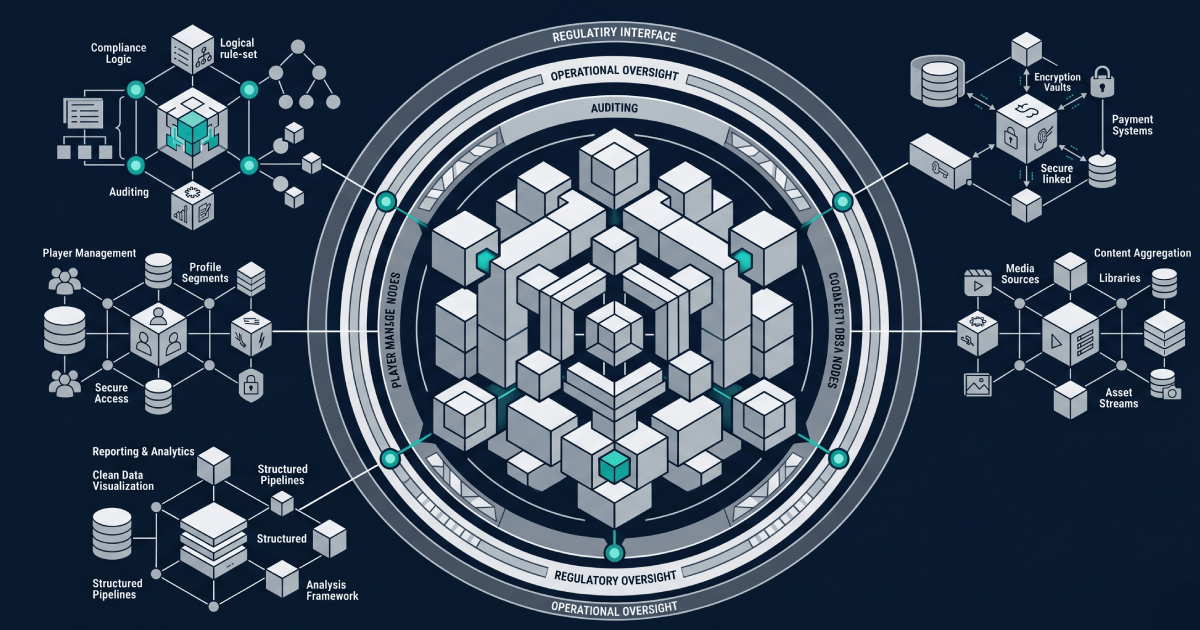
Architecture design precedes feature design. The service boundaries (wallet, PAM, game integration, responsible gambling, reporting) need to be defined before you start building features. Get this wrong and you’ll be re-architecting under commercial pressure twelve months later.
Agile sprints with regulatory gates. Standard two-week sprints work, but you need compliance review gates at defined milestones. A responsible gambling feature that ships without compliance sign-off is a regulatory risk, not a velocity win.
QA for iGaming is specialised. Beyond standard functional and regression testing, you need load testing that simulates peak concurrent players (Saturday afternoon during Premier League season, for sportsbook operators), security penetration testing that covers payment flows, game round integrity verification against RNG certification requirements, and responsible gambling flow testing that validates cooling-off periods, limit enforcement, and self-exclusion propagation. You also need to test across a device matrix that reflects your actual player base, not just the latest iPhone. A meaningful percentage of UK players are on Android devices that are two to three generations old.
Soft launch in a single jurisdiction before multi-market rollout. Launching in MGA first while preparing for UKGC is a common pattern. It lets you validate your architecture under real player load in a regulated environment before entering the higher-scrutiny UK market.
Results Are Designed, Not Hoped For
Clear Objectives. Tangible Outcomes.
Well engineered software is only part of the equation. True impact comes from aligning technology with commercial intent from the outset.
We define success early, measure consistently and refine continuously to ensure every product delivers meaningful and sustained value.

Critical Tech Stack Decisions: Native vs. Cross-Platform
This decision gets oversimplified in most discussions. The right answer depends on what you’re building and where your performance thresholds are.
Native (Swift for iOS, Kotlin for Android) gives you the best rendering performance, the lowest latency for animations and transitions, direct access to platform APIs (biometric auth, push notifications, ARKit/ARCore if relevant), and the smoothest WebView performance for hosting HTML5 game content. For operators where the mobile app is the primary revenue channel and the game lobby experience needs to compete with best-in-class consumer apps, native is the right call.
The cost is maintaining two codebases. For a team with strong iOS and Android capability, this is manageable. For operators who are building their first in-house engineering function, it’s a meaningful overhead.
Cross-platform (Flutter, primarily; React Native less commonly in iGaming) gives you a single codebase deploying to both platforms. Flutter’s rendering engine (Skia, or Impeller in recent versions) performs well for most iGaming UX patterns: lists, grids, navigation, forms, betslip interactions. Where it falls short is in scenarios requiring heavy WebView interaction (which is how most HTML5 games are hosted within the app) and in platform-specific edge cases around payment sheet integration and biometric flows.
The pragmatic recommendation: if your app is primarily a container for WebView-hosted games (which describes most casino-first operators), the rendering framework matters less than your WebView performance tuning. In that case, Flutter with well-optimised WebView handling can deliver a strong experience at lower development cost. If your app has a substantial native UI surface (custom sportsbook UX, live streaming integration, complex betslip interactions), native gives you fewer compromises.
Avoid the trap of choosing a framework based on developer availability alone. The most expensive tech stack decision is the one you have to reverse eighteen months in.
Partnering with Jadex for Market-Defining Products
The decisions outlined above (wallet architecture, tech stack, regulatory engineering, partner selection) determine whether your mobile app becomes a competitive advantage or an expensive maintenance burden.
Jadex has delivered platform and product engineering for tier-one regulated operators including Rank Group and DAZN, working at the intersection of complex regulatory requirements and commercial performance demands. This is work in UKGC, MGA, and GGC regulated environments, not adjacent to them.
If you’re evaluating a migration from white-label to bespoke, scoping a platform modernisation, or building a new mobile product for a regulated market, a technical conversation with someone who’s done this work is more valuable than another RFP response.
Schedule a consultation to discuss your platform architecture, regulatory requirements, and commercial objectives. The conversation starts with your specific constraints, not a sales deck.
Frequently Asked Questions
Latest from our blog
Insights & Perspectives
Our insights explore the intersection of technology, commercial strategy and disciplined execution across complex digital environments.