Enterprise Casino Software: A Framework for Technical Decision-Makers
Most enterprise casino software evaluations fail before they start. The RFP goes out with 200 line items, vendors check every box, and eighteen months later the platform still can’t handle a regulatory change without a six-figure change request. The problem isn’t the software. It’s the evaluation framework. This article provides a structured approach for assessing platform architecture across the dimensions that actually determine whether enterprise casino software serves your operation or constrains it: compliance adaptability, wallet architecture, integration flexibility, and total cost of ownership over a realistic timeline.









Every platform vendor claims enterprise-grade capability. The term has been diluted to the point of meaninglessness. In a regulated iGaming context, enterprise-grade has a specific, testable definition that most platforms fail to meet once you look past the feature matrix.
It starts with non-functional requirements. A demo can show you a bonus engine. It can’t show you whether that bonus engine maintains sub-200ms response times when 40,000 concurrent players trigger a promotion simultaneously during a Premier League Saturday afternoon. It can’t demonstrate whether the audit trail holds up under UKGC Section 116 scrutiny or whether the data architecture supports the granularity of reporting that MGA Technical Standards require.
Enterprise-grade in iGaming means three things simultaneously:
Architectural resilience under load. Not theoretical throughput numbers, but demonstrated capacity during peak events with graceful degradation patterns. How does the platform behave when a dependent service (a payment provider, a game provider feed) goes down? Does the wallet freeze? Does the player session survive?
Regulatory auditability at the data layer. Every transaction, every state change, every player interaction must be reconstructable. Not summarized. Reconstructable. UKGC’s Remote Gambling and Software Technical Standards (RTS) require this. MGA’s Technical Standards specify it. If your platform can’t produce a complete, time-ordered audit trail for any player account within minutes, it’s not enterprise-grade. It’s a liability.
Operational independence from the vendor roadmap. This is where most white-label arrangements break down. If you need to implement a new responsible gambling intervention because the Gambling Commission has issued updated formal guidance, can you do it without submitting a change request and waiting for the vendor’s next sprint cycle? If the answer is no, you’re not running an enterprise platform. You’re renting one.
The distinction matters because regulatory timelines don’t wait for vendor release schedules. When UKGC tightened affordability check requirements, operators on inflexible platforms scrambled. Those with genuine enterprise-grade architecture, where the compliance layer could be modified independently of the game delivery layer, adapted in weeks rather than months.
The architecture conversation in iGaming usually starts with microservices versus monolith, which is the wrong starting point. The right starting point is: what are your deployment constraints, and how frequently does regulation force architectural change?
Modular architecture matters in this space not because it’s fashionable, but because regulatory requirements in different jurisdictions diverge. UKGC requires specific responsible gambling interventions. MGA has different reporting cadences. GGC has its own technical standards. If your geo-compliance module is tightly coupled to your player account management system, every jurisdictional variation becomes a cross-cutting concern that touches half your codebase.
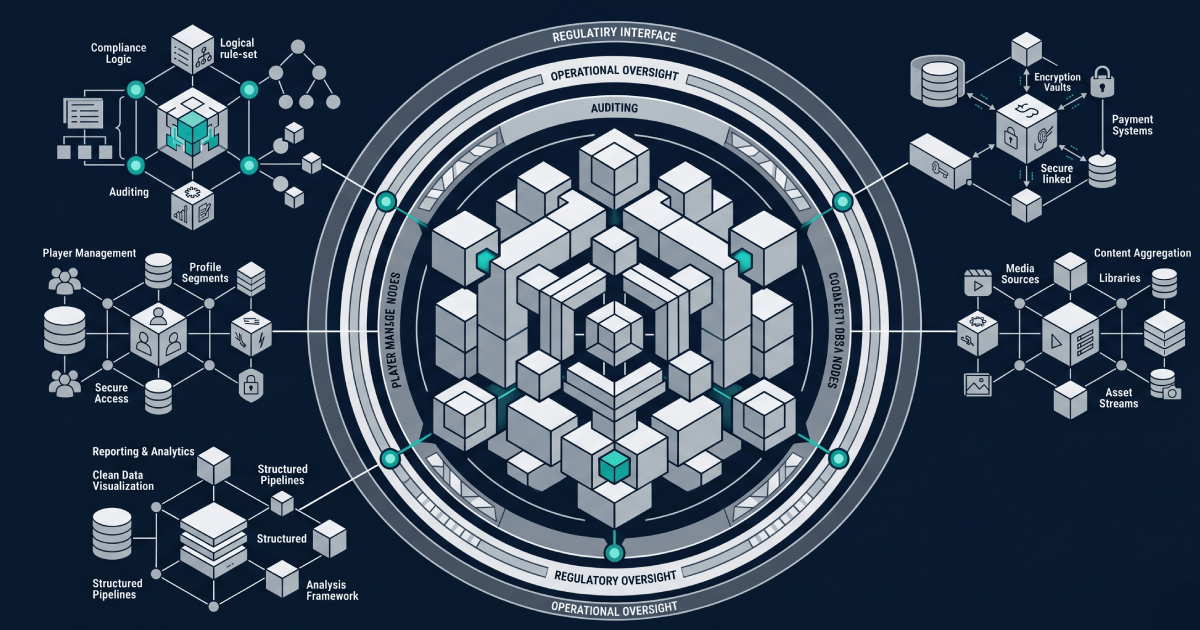
A well-designed enterprise casino platform separates these concerns at the service boundary level. The compliance engine should be independently deployable. The responsible gambling tooling should be configurable per jurisdiction without redeployment of core services. This isn’t aspirational architecture. It’s a practical requirement for any operator running in more than one regulated market.
On scalability: the relevant metric isn’t peak concurrent users in isolation. It’s peak concurrent users during a promotional event while simultaneously processing withdrawal requests, running AML batch analysis, and serving real-time game feeds from 30+ providers. Cloud infrastructure (whether AWS, GCP, or Azure) provides the elastic compute layer, but the application architecture determines whether that elasticity actually translates to consistent player experience. Auto-scaling a monolith that holds session state in memory accomplishes nothing.
Security in iGaming goes beyond standard web application protections. Multi-layered protection here means: encryption at rest and in transit (table stakes), tokenized PII storage, network segmentation between player-facing services and back-office systems, and real-time transaction monitoring that can flag anomalous patterns before funds leave the system. KYC and AML aren’t bolted-on compliance features. They’re core platform capabilities that need to operate at transaction speed, not batch speed, if you want to meet both regulatory expectations and fraud prevention realities.
The platforms that get this right treat compliance as a first-class architectural concern, not a reporting layer that sits on top of the operational database. The ones that get it wrong are the ones generating six-figure remediation invoices every time a regulator tightens the rules.
Player acquisition costs in regulated markets keep climbing. UKGC-regulated operators face particular pressure because marketing restrictions narrow the funnel while compliance costs widen the base. Retention infrastructure isn’t optional; it’s the economics of the business.
Integrated CRM in an iGaming context means the system has access to real-time player behavioral data: session frequency, game preferences, deposit patterns, bonus conversion rates, and responsible gambling interactions. If your CRM operates on a batch data feed that’s six hours old, your “real-time” triggered communications are anything but. The integration between PAM and CRM determines the ceiling of your personalization capability.
Gamification (tournaments, leaderboards, loyalty point systems, achievement mechanics) works. The evidence from operators who’ve implemented it properly shows measurable increases in session duration and visit frequency. The implementation challenge is that gamification engines need to interact with the wallet (for reward distribution), the bonus engine (for promotional tie-ins), the CRM (for communication triggers), and the game integration layer (for qualifying activity tracking). A gamification system that operates as a standalone overlay without deep platform integration produces a disconnected player experience.
AI and ML in player engagement deserve honest treatment. The vendor pitch usually involves real-time personalization models that predict churn, improve bonus offers, and detect problem gambling patterns. The reality is that these models require clean, structured, high-volume behavioral data as input. If your data infrastructure consists of application logs and a reporting database with daily ETL jobs, you’re not ready for production ML models regardless of what the vendor demo shows.
The prerequisite stack for effective AI-driven personalization in iGaming looks like this: an event streaming layer capturing player interactions in real time, a feature store that computes behavioral attributes from raw events, a model serving infrastructure that can return predictions within the latency budget of a page load, and a feedback loop that measures actual outcomes against predictions. Most operators are still building step one.
That doesn’t mean AI is irrelevant. It means the platform architecture needs to support the data infrastructure that makes AI viable. Buying an AI engagement tool before building the data pipeline is buying a car before building the road
Results Are Designed, Not Hoped For
Clear Objectives. Tangible Outcomes.
Well engineered software is only part of the equation. True impact comes from aligning technology with commercial intent from the outset.
We define success early, measure consistently and refine continuously to ensure every product delivers meaningful and sustained value.

Implementation Realities: Planning for Migration and Integration
The gap between “contract signed” and “platform live with players” is where most timeline estimates fall apart.
Cloud deployment is standard for new builds. On-premise is rare outside of specific jurisdictional requirements (some emerging markets still mandate local data residency with physical infrastructure). AWS and GCP dominate the iGaming hosting space, with Azure gaining ground in European markets. The hosting decision is less about which cloud provider and more about whether the platform is genuinely cloud-native (containerized, orchestrated, designed for horizontal scaling) or a traditionally architected application deployed on cloud VMs, which buys you very little elasticity.
API-first architecture isn’t a buzzword here. It’s a practical requirement. Every third-party integration, whether payment providers, KYC services, game aggregators, or CRM platforms, connects via API. The quality of your API layer determines your integration velocity. Well-documented, versioned APIs with sandbox environments allow parallel integration workstreams. Poorly documented or inconsistent APIs force sequential integration with extensive back-and-forth, adding weeks to each integration.
A realistic implementation timeline for a mid-complexity deployment:
Weeks 1-4: Environment provisioning, core platform configuration, initial API integration setup. Discovery of the first significant gap between what was promised and what exists.
Weeks 5-12: Payment provider integrations (expect at least two to take longer than quoted), game aggregator integration and content configuration, KYC/AML provider integration, CRM configuration.
Weeks 13-18: UAT, regulatory submission (if required), load testing, security penetration testing, responsible gambling tooling validation.
Weeks 19-24: Soft launch, monitoring, performance tuning, player migration (if applicable).
That’s a best-case timeline for a turnkey deployment with an established provider. Custom builds add months at the front end for core platform development. Migrations add complexity throughout because you’re running two platforms simultaneously during the transition period.
The risks that consistently cause delays: payment provider onboarding timelines (they operate on their own schedule), regulatory approval processes, and data migration quality issues where legacy player records don’t map cleanly to the new platform’s data model.
Rather than ranking providers (which is meaningless without context), it’s more useful to categorize them by what they actually are and what trade-offs each category carries.
Full-stack platform providers (Playtech, for example) offer everything: PAM, wallet, game content, sportsbook, CRM, back-office tools. The advantage is a single vendor relationship and pre-integrated components. The disadvantage is deep lock-in. Migrating away from a full-stack provider is the most complex and expensive migration path because every layer of your operation is coupled to their technology. Playtech’s strength in content and distribution is well-established, but their platform architecture reflects decisions made across multiple product generations, which carries implications for operators who need modern API-first integration patterns.
Platform and aggregation specialists (SoftSwiss, for instance) focus on the operator platform layer with game aggregation. They tend to offer more modern API architectures and more flexible deployment models than the legacy full-stack providers. The trade-off is that you’re assembling your stack from multiple vendors, which means managing more integration points and more commercial relationships.
CRM and engagement platforms (Smartico and similar) sit on top of your core platform and provide gamification, CRM automation, and engagement tools. They add capability without replacing your platform, but their effectiveness is directly limited by the quality of data your platform can feed them. If your PAM doesn’t expose real-time behavioral events, the engagement platform is operating with one hand tied behind its back.
When running due diligence on any provider, the questions that matter most are: What does your release cycle look like? How do you handle jurisdiction-specific regulatory changes? Can I see the API documentation before signing? What happens to my data if I leave? What’s the contractual mechanism for a custom feature request? How do you handle wallet reconciliation failures?
The answers to these questions tell you more about the platform than any demo ever will.
Making the Right Platform Decision for Your Operation
The right platform is the one that matches three things: your regulatory obligations, your engineering maturity, and your three to five year commercial trajectory.
An operator with a small engineering team entering their first regulated market should probably start with a turnkey solution and plan a migration path once revenue justifies the investment. An operator doing £10M+ monthly GGR on a revenue share white-label with a twenty-person engineering team is almost certainly leaving money on the table by not building or migrating to a custom or hybrid platform.
The questions to answer before any evaluation starts: How many jurisdictions will you operate in within three years? What’s your projected GGR trajectory? How much engineering capability do you have or are willing to build? How important is player experience differentiation to your commercial strategy? How frequently are your current regulatory requirements changing?
These answers shape the decision more than any vendor comparison matrix. The platform that’s right for a multi-brand operator managing five jurisdictions with an established engineering team looks nothing like the platform that’s right for a single-brand operator launching in one market.
For operators working through this evaluation, particularly those managing migrations from white-label to custom architecture or modernizing legacy platforms under regulatory pressure, specialist engineering consultancies with tier-one operator experience (working with organizations like Rank Group, Mecca, and DAZN Bet) bring implementation knowledge that neither pure technology vendors nor generalist consultancies can match. They’ve seen where the architecture breaks, where the migration risks hide, and where the vendor claims diverge from platform reality.
The framework in this article gives you the structure for the evaluation. The implementation requires people who’ve done it before.
Frequently Asked Questions
Latest from our blog
Insights & Perspectives
Our insights explore the intersection of technology, commercial strategy and disciplined execution across complex digital environments.