Scalable Gambling Platforms: The Technical Blueprint for Regulated Markets
A platform that can’t absorb a UKGC affordability check change within a single sprint costs you more than engineering hours. It costs you market access. This article breaks down the architectural decisions, cloud infrastructure trade-offs, cost drivers, and compliance engineering patterns that determine whether a regulated iGaming platform scales with your business or against it.










Scalability conversations in iGaming usually start in engineering and stay there. That’s a mistake. When your platform can’t horizontally scale to handle a Cheltenham Festival Saturday, you’re not just looking at latency spikes. You’re looking at abandoned bets, player churn, and regulatory scrutiny if responsible gaming controls degrade under load.
The financial arithmetic is straightforward. A tier-one UK sportsbook processing £2M+ in bets per hour during a major event loses real revenue for every minute of degraded service. But the less obvious cost is what happens between those events: the slow accumulation of technical debt that makes regulatory adaptation expensive and slow.
UKGC‘s pace of change has accelerated. The white paper reforms, tightening affordability checks, enhanced due diligence triggers, stake limits on slots. Each regulatory change translates to platform work. If your architecture requires a full regression cycle to modify a deposit limit threshold, or if your wallet and compliance services are tightly coupled so that a change to one risks breaking the other, you’re paying a compounding tax on every regulatory update.
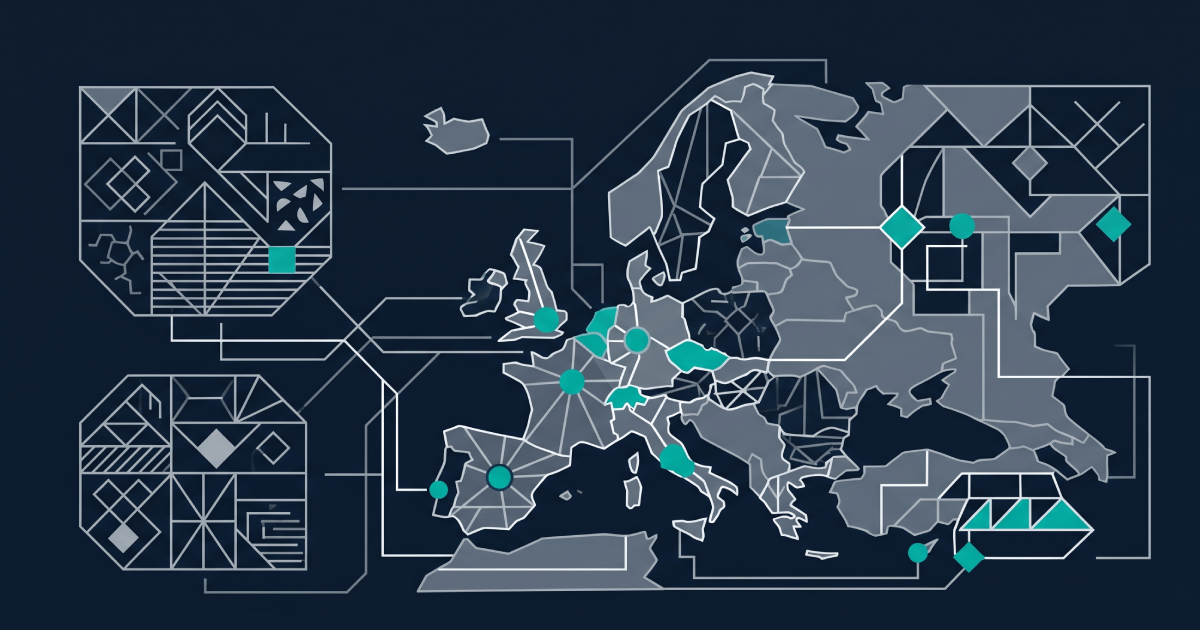
Fragmented markets amplify this. An operator licensed in the UK, Malta, and Gibraltar, with eyes on Ontario or a Latin American jurisdiction, needs a platform that can absorb different rulesets without forking the codebase. Monolithic platforms struggle here. They force you into jurisdiction-specific branches that diverge over time, making each subsequent market entry slower and more expensive.
The return on investment case for scalable architecture isn’t hypothetical. It’s the difference between a six-week compliance change and a six-month one. Between entering a new market in three months and twelve. Between a peak event that converts players and one that loses them.
The microservices vs. monolith debate in iGaming gets oversimplified. Neither is universally correct. The right answer depends on your team size, operational maturity, and how many jurisdictions you’re serving.
A monolith can be the right starting point for a single-market operator launching quickly. It’s simpler to deploy, simpler to test, and doesn’t require the distributed systems expertise that microservices demand. The problems come later: when you need to scale your wallet service independently of your CMS, when a bug in bonus processing brings down player registration, when deploying a regulatory change to one module means redeploying everything.
Microservices solve these problems by enabling independent scaling and fault isolation. Your wallet service (which needs to handle thousands of transactions per second during peak) can scale horizontally without scaling your back-office reporting. Your compliance module can be updated and deployed without touching game integration. A failure in your promotional engine doesn’t cascade into your payment processing.
But microservices carry real costs. You need service mesh management (Istio, Linkerd, or equivalent). You need distributed tracing to debug issues across service boundaries. You need teams organised around service ownership, not functional silos. The operational overhead of running 30+ microservices is genuinely high, and if your engineering org isn’t structured for it, you’ll end up with a distributed monolith: all the complexity, none of the benefits.
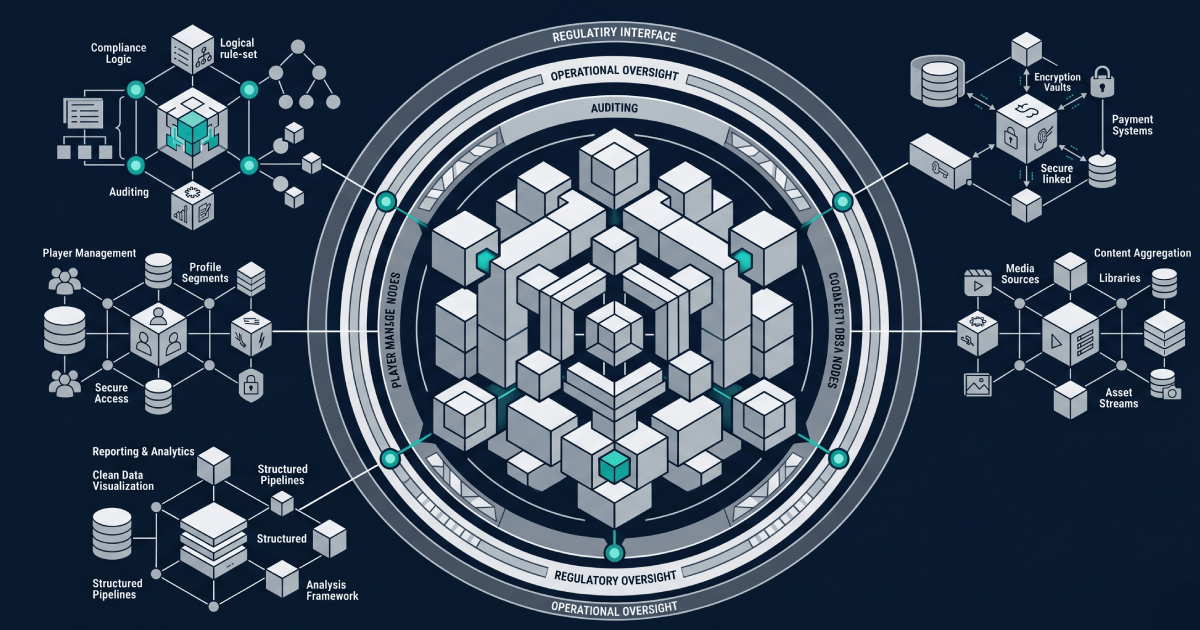
A modular monolith offers a pragmatic middle path. You define clear boundaries between domains (wallet, PAM, compliance, game aggregation) within a single deployable unit, with the explicit intent to extract services as scaling requirements justify the complexity. This gives you the domain separation that matters for regulatory work without the Day 1 operational overhead of full microservices.
Most operators at the 50,000 to 500,000 active player range would be well served by starting with a modular monolith and extracting the wallet service and compliance module as independent services first. Those are the two domains where independent deployment and scaling deliver the clearest value.
All three major providers can host regulated iGaming workloads. The differences matter at the margins, and those margins affect your TCO and operational capability.
AWS has the deepest adoption in iGaming. The system is mature: RDS and Aurora for managed relational databases, Kinesis for real-time streaming (useful for feeding player event data into fraud detection and personalisation systems), ECS/EKS for container orchestration, and a broad set of regions including eu-west-1 (Ireland) and eu-west-2 (London), which matter for data residency. The trade-off: AWS pricing is complex, and without disciplined cost management (reserved instances, savings plans, right-sizing), bills escalate quickly.
Azure is strongest when your organisation already has Microsoft enterprise agreements or when you need hybrid cloud connectivity to on-premises systems (common in retail-online hybrid operators like those running both physical venues and online platforms). Azure’s compliance certification portfolio is extensive, and its EU data boundary commitments are clearly documented. Its Kubernetes offering (AKS) is solid, though the broader service system is slightly less mature than AWS for data engineering workloads.
GCP offers compelling pricing for data-heavy workloads. BigQuery is genuinely strong for analytics at scale, and GCP’s networking (premium tier) delivers consistent low-latency performance. The constraint: GCP has fewer European regions than AWS, and its market share in regulated iGaming is smaller, meaning fewer reference architectures and fewer engineers with GCP-specific iGaming experience. That talent gap is a real operational risk.
Data residency is non-negotiable. UKGC requires player data to be accessible and, depending on interpretation, stored in ways that enable regulatory access. MGA has its own requirements, and GDPR applies across all EU-facing operations. Your cloud choice must support the region configurations your licensing demands. Multi-region deployments add complexity and cost, but for multi-jurisdictional operators they aren’t optional.
For most regulated operators, AWS is the default choice unless there’s a strong existing reason to go elsewhere. The talent pool is larger, the iGaming-specific reference architectures are more numerous, and the managed services for databases and streaming are mature. That said, “default” doesn’t mean “optimal for every workload.” Analytics pipelines might run more cost-effectively on GCP’s BigQuery. The right answer is usually a primary cloud with selective use of best-of-breed services where justified.
Results Are Designed, Not Hoped For
Clear Objectives. Tangible Outcomes.
Well engineered software is only part of the equation. True impact comes from aligning technology with commercial intent from the outset.
We define success early, measure consistently and refine continuously to ensure every product delivers meaningful and sustained value.

Engineering for Multi-Jurisdictional Compliance
Compliance logic must be a first-class architectural concern, not a layer bolted on after the platform ships.
The practical challenge: UKGC, MGA, and Gibraltar’s GGC each have different requirements for KYC timing, deposit limit structures, self-exclusion integration, marketing consent, and regulatory reporting formats. Emerging US state regulators add further variation. Your platform needs to enforce the right rules for the right player in the right jurisdiction, in real time.
A configuration-driven compliance module is the pattern that works. Define each jurisdiction’s rules as a rule set: KYC verification required within 72 hours of registration (UKGC), or before first deposit (some markets). Deposit limits configurable per jurisdiction. Self-exclusion integrated with GAMSTOP for UK, with different national schemes elsewhere. Affordability check triggers at jurisdiction-defined thresholds.
These rule sets should be versioned and deployable independently. When UKGC tightens an affordability trigger threshold, you update the UK rule set, test it in isolation, and deploy it without touching your MGA or GGC configurations. This is where microservices (or at minimum, a well-separated compliance module) pay for themselves.
Audit logging is not optional. Every player interaction that has regulatory significance (login, deposit, bet, withdrawal, limit change, self-exclusion) must be logged with timestamps, immutably stored, and queryable. Regulators will ask for this data during licence reviews. If you can’t produce it quickly and accurately, you have a licensing risk.
Responsible gaming tools deserve specific attention. UKGC’s direction of travel is clear: more intervention, earlier, with better data. Your platform should be able to trigger automated interventions (pop-up warnings, mandatory cool-off periods, deposit limit suggestions) based on real-time analysis of player behaviour patterns, not just static thresholds. This requires your player event stream to feed into a rules engine or ML model with low latency, which circles back to your event-driven architecture and data infrastructure.
Most AI vendor pitches to iGaming operators skip the hardest part: data infrastructure.
AI-driven personalisation (game recommendations, bonus targeting, churn prediction) and real-time fraud detection both require the same foundation: a reliable, low-latency stream of player events flowing into a system that can process them. Without that pipeline, your ML models have nothing to score against.
An event-driven architecture using Kafka (or AWS Kinesis, or Azure Event Hubs) as the backbone is the standard approach. Every meaningful player action (bet placed, game opened, deposit made, session started) publishes an event. Downstream consumers process these events for different purposes: one consumer feeds a real-time fraud scoring model, another feeds a personalisation engine, a third writes to an analytics data warehouse.
The prerequisite most operators underestimate is data quality. If your event schema is inconsistent, if player identifiers aren’t unified across systems, if timestamps aren’t synchronised, your ML models will produce unreliable outputs. Getting the data pipeline right takes 60-70% of the effort in any AI initiative. The model training and deployment is the smaller piece.
For player engagement, start with simpler ML applications before reaching for deep learning. Collaborative filtering for game recommendations, logistic regression for churn prediction, rule-based systems augmented with statistical thresholds for fraud detection. These are deployable with smaller data science teams, interpretable (which matters when regulators ask why a player was flagged), and easier to validate.
Real-time AML monitoring requires transaction-level scoring with sub-second latency. This is only possible if your wallet service emits events that a scoring service can consume in real time. If your wallet is a third-party black box that provides daily batch exports, you cannot build real-time AML. Full stop. This is one of the strongest arguments for owning your wallet service.
Choosing Your Platform Development Partner
If you’re outsourcing platform development, vendor due diligence needs to go deeper than a capabilities deck.
Ask for architectural diagrams from a platform they’ve built for a UKGC-licensed operator. Not wireframes. Not marketing slides. An actual system architecture showing service boundaries, data flows, and integration points. If they can’t or won’t provide this (even anonymised), that’s a signal.
Ask how they handle data segregation for multi-brand deployments. Are brands logically separated within a shared database, or physically separated? What’s their approach to tenant isolation? This has implications for both security and regulatory compliance.
Ask about their experience with specific game aggregator APIs. Integration with Evolution’s live casino API is different from integrating Pragmatic Play’s slots API. If they claim to support “all major providers,” ask them to walk through the integration architecture for three specific providers you use.
Ask for their approach to regulatory change management. How do they handle a UKGC consultation response that requires platform changes within 90 days? What’s their testing strategy for compliance changes? Do they have a separate compliance testing environment that mirrors production regulatory configurations?
Check for experience with tier-one operators. Building a platform that handles 10,000 concurrent users is different from building one that handles 200,000. Ask for specific load testing results and the methodology used.
Ask about post-launch support models. A development partner that builds and hands over is less valuable than one that provides ongoing support, because the team that built the system understands its behaviour under stress better than a team inheriting it.
Finally, ask about their team’s availability and continuity. High turnover on a platform build means knowledge loss at every rotation. Ask what their average engineer tenure is on iGaming projects and how they handle knowledge transfer.
The right partner won’t have perfect answers to all of these questions. But they’ll engage with them technically, acknowledge trade-offs honestly, and demonstrate that they’ve solved these problems before in a regulated context. That’s the baseline you should be evaluating against.
Frequently Asked Questions
Latest from our blog
Insights & Perspectives
Our insights explore the intersection of technology, commercial strategy and disciplined execution across complex digital environments.