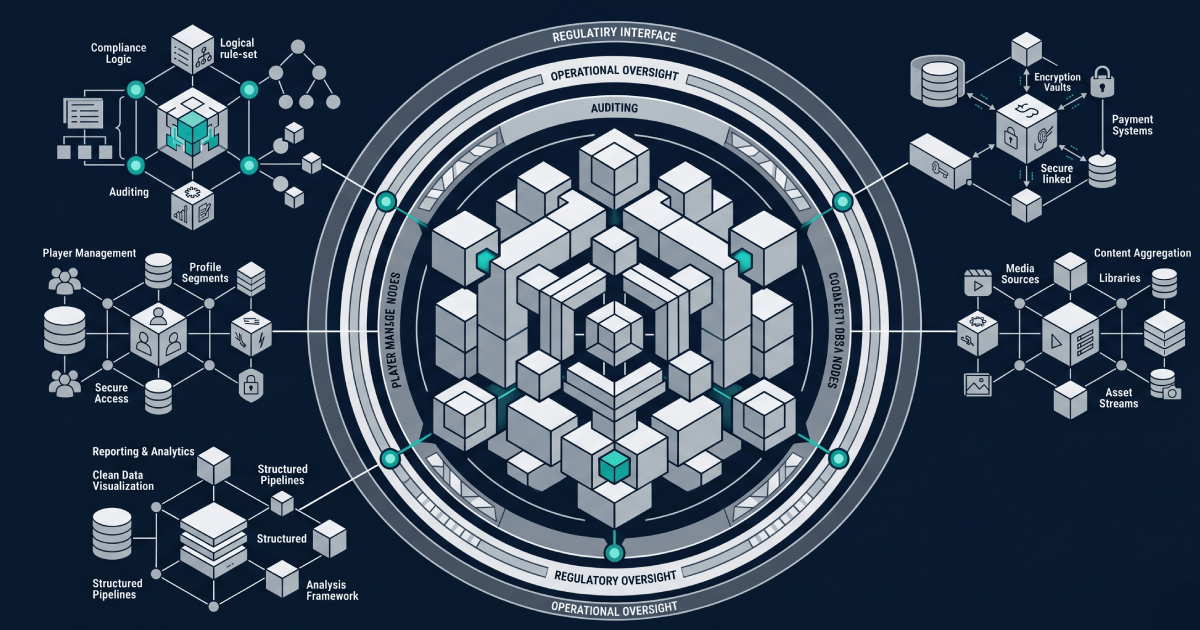
Enterprise Sports Betting Platform Development










White label sportsbook platforms solve a specific problem: getting to market fast with minimal capital expenditure. For operators entering a new jurisdiction to test demand, that trade-off makes sense. The trouble starts around year two.
Revenue share models that seemed palatable at £2M GGR become painful at £20M. Feature requests sit in a vendor backlog behind twenty other operators with competing priorities. The customisation that would differentiate your product from the identical skin running on the same platform? It is either impossible or quoted at a price that makes custom development look cheap by comparison.
Then there is the technical debt dimension. Legacy platforms, whether white label or first-generation custom builds, accumulate architectural decisions that made sense under previous regulatory regimes. UKGC‘s tightening affordability check requirements, MGA‘s changing AML frameworks, new state-level regulations in the US: each change applied to a monolithic codebase compounds complexity. Eventually, the cost of regulatory adaptation on a legacy platform exceeds the cost of building something purpose-fit.
The strategic case for a custom platform comes down to three things. First, margin protection: eliminating revenue share and controlling infrastructure costs directly. Second, product velocity: shipping features on your own roadmap, not waiting for a vendor’s quarterly release cycle. Third, regulatory agility: architecting for compliance change as a first-class concern rather than retrofitting it onto someone else’s design decisions.
None of this means custom is always the right answer. But if you are operating at scale in multiple regulated jurisdictions, the economics and the operational constraints almost always push you toward ownership.
The architectural pattern that has proven most effective for enterprise sportsbook platforms is domain-driven microservices, with each bounded context (betting, trading, wallet, player management, compliance) deployed and scaled independently.
This is not about following trends. It is about matching the deployment model to the operational reality: when MGA requires a change to responsible gambling tooling, you deploy the player management service without touching the betting engine.
When a new market launch requires a different payment provider, you update the payment gateway service without a full platform release cycle.An API-first, headless approach separates the platform’s business logic from its presentation layer entirely. The same backend services power the web app, native mobile apps, and retail terminal integrations through a consistent API surface. This means the frontend team can ship UX improvements independently of backend deployments, and new channels can be added without re-engineering core services.Technology choices should follow from the problem domain, not from what is fashionable.
High-throughput, low-latency services like odds calculation and bet placement benefit from languages with strong concurrency models (Go, Rust, or JVM-based options). Data pipeline and ML workloads fit Python’s ecosystem naturally.
Event streaming through Kafka provides the real-time backbone. PostgreSQL handles transactional data where ACID compliance matters; Redis or similar provides the caching layer for odds and market state.
Containerised deployment via Kubernetes enables auto-scaling for predictable traffic spikes (Saturday 3pm, Super Bowl, Cheltenham) and provides the infrastructure abstraction needed for multi-region deployment across jurisdictions.
Results Are Designed, Not Hoped For
Clear Objectives. Tangible Outcomes.
Well engineered software is only part of the equation. True impact comes from aligning technology with commercial intent from the outset.
We define success early, measure consistently and refine continuously to ensure every product delivers meaningful and sustained value.

Engineering for Regulatory Compliance
Compliance is not a feature you add after launch. It is an architectural constraint that shapes every design decision from day one.
UKGC requirements are the most prescriptive in the industry. Source of funds checks, affordability triggers, interaction frameworks for at-risk players, enhanced customer due diligence, and strict marketing consent rules all have technical implementations. The platform needs configurable thresholds, automated trigger workflows, and complete audit trails. The recent tightening around financial vulnerability assessments means platforms need to process third-party data (credit reference agency checks, Open Banking data) within the player journey without unacceptable friction.
MGA operates under a different model but with its own technical requirements: player protection directives, AML reporting obligations, game fairness verification, and data retention rules that differ from UK standards.
Gibraltar’s GGC adds another set of expectations, including specific requirements around system testing, change management processes, and business continuity.
US state regulations vary enormously. Geolocation verification (GeoComply integration is effectively mandatory), state-specific tax reporting, age verification, and responsible gambling requirements differ between New Jersey, Pennsylvania, Michigan, and every other regulated state.
The engineering pattern that handles this is a compliance rules engine with jurisdiction-specific configuration. Rather than branching code paths for each market (which creates maintenance nightmares), you define compliance rules as configurable policies that are applied based on the player’s jurisdiction. Deposit limits, self-exclusion periods, session time reminders, affordability thresholds: all parameterised, all auditable, all deployable per jurisdiction without code changes.
Responsible gambling tools deserve specific mention. Deposit limits, loss limits, session time limits, cooling-off periods, self-exclusion (with integration into GamStop in the UK and equivalent schemes elsewhere): these are not optional features. They are regulatory requirements with specific technical specifications around how they must behave, how quickly they must take effect, and how they must be reported.
Scope Your Next-Generation Betting Platform
The operators who get the best outcomes from custom platform development are the ones who invest properly in the scoping phase. Before a line of production code gets written, you need clarity on target markets and their regulatory requirements, your trading model and risk appetite, integration requirements with existing systems and third-party services, and the player experience that will differentiate your product.
If you are evaluating a migration from white label to custom, assessing the cost of modernising a legacy platform, or planning a new market entry that your current technology cannot support, the first step is a structured technical scoping session. No pitch deck, no generic demo. A focused conversation between your technical leadership and ours about your specific architecture, constraints, and objectives.
Frequently Asked Questions
Latest from our blog
Insights & Perspectives
Our insights explore the intersection of technology, commercial strategy and disciplined execution across complex digital environments.