Turnkey Casino Solutions: A Technical Framework for Operators
Most turnkey casino vendors sell the same pitch: go live in weeks, not months. A pre-built stack, bundled licensing support, game aggregation out of the box. For operators under pressure from investors or regulators to launch fast, it sounds right. But the gap between that pitch and what you actually inherit, architecturally, commercially, and operationally, is where platform decisions go wrong. What follows is a technical framework for evaluating turnkey solutions honestly, built from the perspective of engineers who build custom platforms and know exactly where packaged ones bend and where they break.






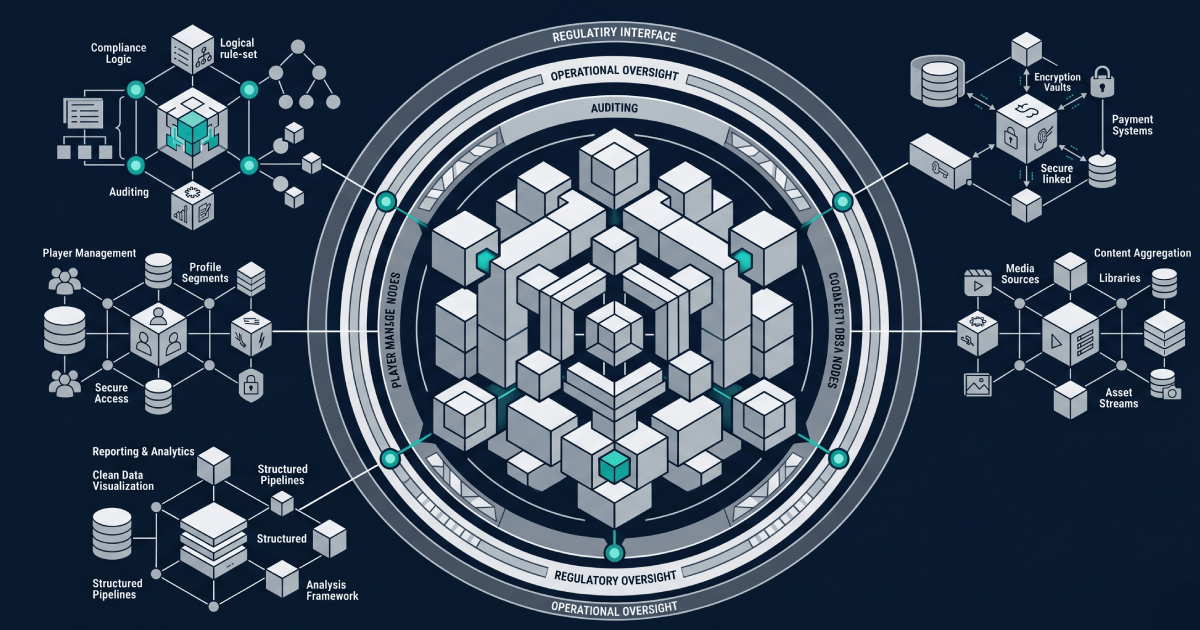
The appeal is real. A turnkey casino solution compresses months of development into a configuration exercise. You get a PAM, a CMS, a game lobby, payment integrations, and some flavour of CRM in a single deployment. For iGaming operators entering a new jurisdiction or standing up a new brand under time pressure, the time-to-revenue argument is compelling.
But speed to market creates a specific kind of technical debt that’s easy to underestimate during procurement. You’re inheriting someone else’s architecture, their data model, their API conventions, their deployment cadence. Your product roadmap becomes a feature request queue managed by a vendor with dozens of other clients pulling in different directions. Roadmap dependency isn’t a hypothetical risk. It’s the default operating model.
The operators who get hurt aren’t the ones who launch on turnkey. They’re the ones who launch on turnkey without a clear picture of when and how they’ll need to diverge from it. A turnkey platform works until your business needs something the vendor didn’t anticipate. That moment arrives faster than most operators expect, usually triggered by a regulatory change, a commercial requirement for bespoke player segmentation, or a wallet architecture that can’t support the fraud detection model your compliance team is demanding.
If you’re evaluating this path, the question isn’t whether turnkey gets you live faster. It does. The question is what it costs you in years two through five when the platform becomes a constraint rather than an accelerator.
There’s a persistent confusion in the market between a vendor providing a “compliant platform” and a vendor helping you achieve or maintain regulatory compliance. These are different things.
A turnkey provider can offer a platform that has been certified for a given jurisdiction. The technical testing (GLI, eCOGRA, or equivalent lab certification), RNG validation, and platform security audits are the vendor’s responsibility on a shared stack. That’s genuine value.
But the gambling licence sits with the operator. Responsible gambling obligations, AML/KYC execution, marketing compliance, customer interaction requirements under LCCP (for UKGC licensees): these are your obligations regardless of whose platform you run on.
Where this gets difficult: UKGC’s changing expectations around customer interaction and affordability assessments require configurable threshold logic, real-time data feeds from wallet services, and audit trails that demonstrate compliance decisions. If your turnkey platform’s responsible gambling module offers five configurable fields when you need fifteen, and the vendor’s roadmap doesn’t prioritise your jurisdiction’s requirements, you’re exposed.
MGA operators face similar friction. The updated Player Protection Directive requires operators to demonstrate specific technical controls. If those controls live inside a vendor’s codebase and you can’t inspect, configure, or extend them independently, your compliance team is operating partially blind.
The practical question for due diligence: ask the vendor for a complete list of regulatory controls, their configuration options, and their change request process. How long does a compliance-driven platform change take from request to production? If the answer is “it depends” without specifics, that tells you something.
The first 12 months on a turnkey platform are usually fine. The friction starts in year two. Your product team wants a feature the vendor doesn’t prioritise. Your data team needs event-level behavioural data that the platform doesn’t expose. Your compliance team needs a threshold change deployed in days, not the vendor’s standard four-week development cycle.
Scalability ceilings are real. Multi-brand operators running several skins on a single turnkey instance hit performance and configuration limits. Multi-jurisdiction deployments require regulatory partitioning (separate wallet services, different RG rules, jurisdiction-specific reporting) that shared platforms handle with varying degrees of elegance. Ask the vendor how many concurrent brands they support on a single instance, and what happens to performance at that scale.
Data ownership determines your AI and ML capability. Every operator talks about personalisation, real-time player risk scoring, and predictive churn modelling. None of that works if you can’t access your own data at the event level with low latency. If the turnkey platform treats player data as a managed asset rather than an operator-owned resource, your data science team is building models on sand. Review the data ownership clauses in the contract with your legal team. “You own your data” is meaningless if extraction is technically impractical.
Plan the exit before you enter. The most overlooked element of turnkey procurement is the migration path away from it. Contractual lock-in periods, data portability mechanics, player account migration without service interruption: these aren’t hypothetical concerns. They’re the exact problems operators face when they outgrow a turnkey solution and need to move to a custom platform or a different vendor. Map the exit scenario before signing. If the vendor makes exit difficult or expensive by contract design, that’s a commercial signal about how they retain clients.
A pragmatic approach: some operators use turnkey as a launching pad with a planned migration timeline. Launch on turnkey in months one through eighteen while building a custom platform in parallel, then migrate. This hybrid strategy requires upfront investment in two workstreams but avoids both the delayed launch of a custom build and the long-term constraints of vendor dependency.
Results Are Designed, Not Hoped For
Clear Objectives. Tangible Outcomes.
Well engineered software is only part of the equation. True impact comes from aligning technology with commercial intent from the outset.
We define success early, measure consistently and refine continuously to ensure every product delivers meaningful and sustained value.

Analysing the Market: Key Turnkey Provider Architectures
Rather than ranking providers, here’s an architectural lens on how three major turnkey vendors approach the problem differently. Your evaluation should weight these differences against your specific operational requirements.
SoftSwiss has built strong infrastructure around cryptocurrency payment processing, making them a natural fit for crypto-first or crypto-hybrid operators. Their game aggregation layer covers a large provider catalogue. For operators targeting MGA or Curaçao markets with a crypto-heavy player base, the payment stack is a genuine differentiator. The trade-off: operators targeting strictly UKGC-regulated markets may find the platform’s compliance tooling less mature for that specific regulatory framework compared to vendors with deeper UK market focus.
SoftGamings positions itself around breadth of integration options, offering connections to multiple game aggregators and payment providers. This modular approach gives operators more choice in assembling their stack. The risk with modularity is integration surface area: more connectors mean more potential points of failure and more dependency on the vendor maintaining those integrations as upstream APIs change.
Slotegrator has focused on providing turnkey solutions with licensing support across multiple jurisdictions, including emerging markets. For operators entering markets where regulatory frameworks are still developing, the licensing facilitation can reduce time to launch. The architectural consideration: platforms optimised for rapid multi-jurisdiction deployment sometimes sacrifice depth of feature configuration within any single jurisdiction.
None of these providers is universally “best.” The right fit depends on your target markets, payment preferences, regulatory requirements, and the specific components where you need depth versus breadth. Evaluate them against the due diligence checklist above rather than against each other’s marketing pages.
Making the Right Platform Call for Your Operation
The turnkey versus custom decision maps to a few concrete variables: your GGR trajectory, your engineering capability, your regulatory exposure, and your product differentiation strategy.
If you’re launching a new brand in a single jurisdiction with a small team and need to validate the market, turnkey makes sense. Accept the trade-offs, negotiate hard on GGR share rates and exit clauses, and build your data infrastructure independently from day one.
If you’re an established operator with growing GGR, multi-jurisdiction ambitions, and a product vision that requires architectural control, the economics and strategic logic point toward custom development. The upfront cost is higher. The long-term cost of ownership is lower. The ability to respond to regulatory change on your own timeline is the difference between a compliance incident and a routine deployment.
If you’re somewhere in between, and most operators are, the value is in having someone who understands both paths map the trade-offs against your specific situation. Not a vendor selling you their platform. Not a consultancy selling you a twelve-month discovery phase. An engineering team that’s built these platforms, integrated with these aggregators, and shipped under UKGC, MGA, and GGC regulatory constraints.
The platform decision you make this quarter will define your operational ceiling for the next three to five years. Make it with the right technical framework, not the best vendor deck.
Frequently Asked Questions
Latest from our blog
Insights & Perspectives
Our insights explore the intersection of technology, commercial strategy and disciplined execution across complex digital environments.