Turnkey Gambling Software: A Technical Guide for Platform Decision-Makers
Most platform decisions in iGaming aren’t made freely. They’re made under pressure: a license application deadline, a PE portfolio review, a competitor launching in your target market six months ahead of you. That pressure pushes operators toward turnkey solutions without fully understanding what they’re buying, what they’re giving up, and what it will cost to unwind the decision in three years. This article breaks down the turnkey platform stack at the engineering layer, addresses real cost structures, maps the regulatory implications for UKGC and MGA markets, and provides a decision framework for when turnkey makes sense and when it doesn’t.







The turnkey vs. custom build framing is useful as a starting point, but it’s a false binary in practice. The real decision space is a spectrum: pure turnkey at one end, full bespoke build at the other, with various hybrid configurations between them. Most operators end up somewhere in the middle, and the ones who struggle are those who didn’t plan for that from the start.
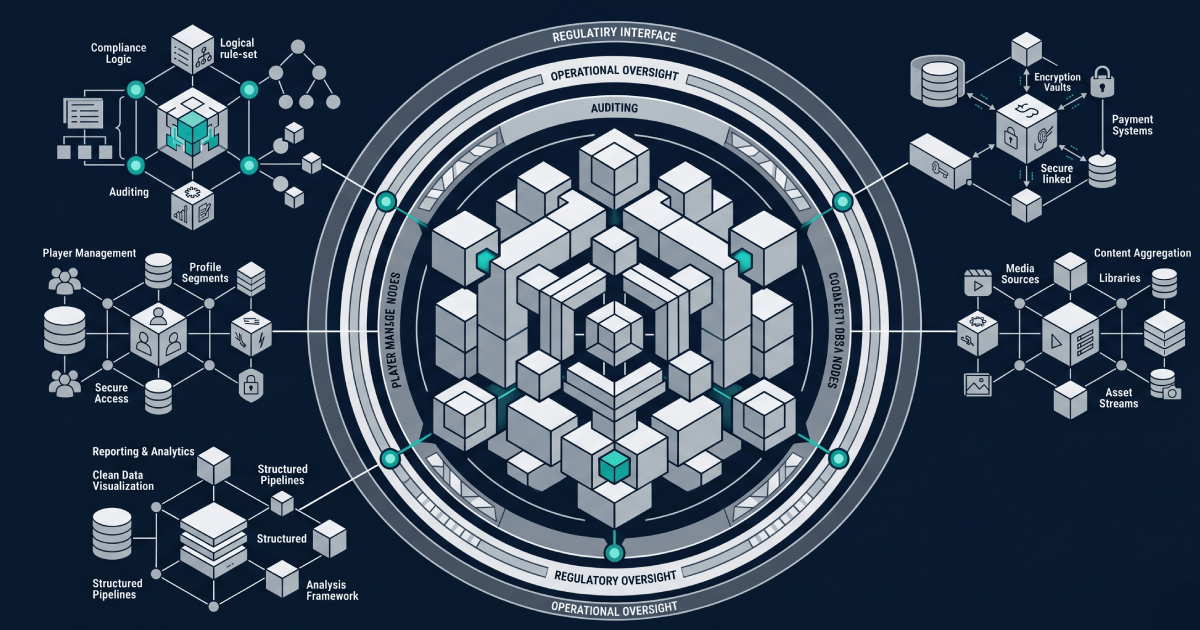
A turnkey solution gives you a pre-built platform stack, typically covering player account management, game aggregation, payments, CRM, and a back office. You get speed to market, often measured in weeks rather than months. You get a licensing path, sometimes through a sub-license arrangement. And you get operational support for a function you may not yet have the internal team to run.
A custom platform gives you control. Control over your data model, your wallet architecture, your integration layer, your compliance tooling, and your product roadmap. But it costs more upfront, takes longer to ship, and requires engineering talent that is genuinely difficult to recruit and retain in this industry.
The trade-offs are not theoretical. Vendor lock-in with a turnkey provider means your product roadmap is their product roadmap. If they don’t prioritize a feature you need for a specific jurisdiction’s compliance deadline, you’re stuck. Conversely, a custom build means you own every bug, every outage, and every compliance gap. There’s no vendor support ticket to escalate to.
The question isn’t which approach is better. It’s which approach matches your operating model, your capital structure, your regulatory obligations, and your product ambitions over a three to five year horizon.
This is where vendor conversations get opaque, and where operators most often underestimate total cost of ownership.
Turnkey pricing typically combines three elements. Setup fees cover platform configuration, branding, initial integrations, and onboarding. Expect a range of €25,000 to €100,000 or more, depending on complexity and jurisdiction. A straightforward Curacao-targeted casino sits at the lower end. A multi-jurisdiction deployment with custom payment integrations and a sportsbook component pushes well above €100,000.
Monthly licensing fees cover ongoing platform access, hosting, and baseline support. These typically run €5,000 to €25,000 per month, depending on traffic volumes and the SLA tier you’ve negotiated.
Revenue share is where the long-term cost compounds. Most turnkey providers charge a percentage of gross gaming revenue (GGR), typically ranging from 5% to 15%. At lower GGR volumes, this feels manageable. At €2M monthly GGR, a 10% rev share is €200,000 per month. At that point, the economic argument for a custom build becomes difficult to ignore.
There are also costs that don’t appear on the rate card. Integration fees for adding new payment providers or game studios. Fees for custom development requests that fall outside the standard roadmap. Penalties or extended notice periods for contract termination. Data migration costs if you decide to leave.
Run a three-year and five-year TCO model before signing. Include projected GGR growth, expected integration requests, and the cost of the engineering team you’d need if you were to build or migrate later. The number that matters isn’t the setup fee. It’s the cumulative cost at the point where you’ve outgrown the platform.
Results Are Designed, Not Hoped For
Clear Objectives. Tangible Outcomes.
Well engineered software is only part of the equation. True impact comes from aligning technology with commercial intent from the outset.
We define success early, measure consistently and refine continuously to ensure every product delivers meaningful and sustained value.

Handling Regulatory Hurdles: Licensing and Compliance Support
The licensing support model varies significantly between turnkey providers, and misunderstanding the differences creates real regulatory risk.
Some providers offer operation under their own license, typically a Curacao or MGA sub-license. This gets you to market fast because you don’t need to apply for your own gambling license. But it comes with significant constraints. You’re operating under someone else’s regulatory umbrella, which means their compliance failures become your operational risk. You have limited control over your compliance posture. And if the provider loses their license or has it suspended, your operation goes dark.
The other model: providers deliver a compliance-ready platform, but you apply for and hold your own license. This is the path for UKGC, MGA, or Gibraltar GGC licensing. It takes longer. It’s more expensive upfront (UKGC application fees alone run into the thousands, plus legal and compliance consultancy). But you own your regulatory relationship, which matters enormously for long-term business value, particularly if you’re considering an exit.
For UKGC-licensed operations specifically, the platform needs to support: LCCP social responsibility code provisions, interaction and affordability assessment tooling, GAMSTOP self-exclusion integration, source of funds checking workflows, and automated regulatory reporting. Ask your turnkey provider exactly which of these are handled natively and which require third-party integrations or manual processes.
MGA-licensed operations have different but overlapping requirements, including player protection rules, AML reporting to the FIAU, and specific technical standards for RNG certification and game fairness.
The compliance architecture question is not “does the platform support compliance?” Every vendor says yes. The question is: when the regulator tightens a requirement with 90 days’ notice, can the platform accommodate the change within that window, or are you dependent on the vendor’s development sprint prioritization?
Rather than ranking providers, which would be stale within months, here’s a framework for evaluation applied to the types of providers you’ll encounter.
SoftSwiss targets operators who want a strong casino-first platform with a broad game aggregation library. Their back office is well-regarded, and their crypto-native capabilities are a differentiator for operators in markets where cryptocurrency payments are relevant. Evaluate them on: API extensibility for custom development, data export capabilities, and how their pricing model scales with GGR growth.
Slotegrator positions for startups and smaller operators entering the market quickly. The entry cost is lower, and the onboarding process is streamlined. The trade-off is typically in customization depth and the sophistication of compliance tooling. If you’re targeting Tier 1 regulated markets (UKGC, MGA), verify that their platform meets the full regulatory technical standard, not just the commercial feature set.
Gamingtec targets more established operators and offers both casino and sportsbook capabilities. Their platform is worth evaluating if you need multi-product (casino plus sports) under a single PAM. Assess them on: sportsbook feed quality and latency, the independence of the casino and sportsbook modules, and whether you can deploy one product without the other.
Every turnkey provider’s sales deck includes the word “customizable.” Pressure-test what that means.
In almost every case, customization refers to the frontend. You can apply your own branding, modify the UI/UX, rearrange the lobby layout, and adjust color schemes and fonts. Some platforms offer a theme builder or CMS-like tools for content management. This is table stakes.
Backend customization is where expectations and reality diverge. The player database schema is fixed. The wallet transaction model is fixed. The bonus calculation logic is fixed. The compliance workflow sequence is fixed. You can configure parameters within these systems (e.g., set deposit limits, define bonus terms), but you can’t change how the systems fundamentally work.
There’s a middle tier that some providers offer: the ability to deploy custom microservices that communicate with the core platform via APIs. This is meaningful if the APIs are rich enough. It’s meaningless if the API surface is shallow or rate-limited to the point where real-time use cases aren’t viable.
The practical test: describe your most important product differentiator to the vendor. The feature that makes your brand different from the 50 other operators on the same platform. Then ask them exactly how you’d implement it. If the answer involves waiting for their development team to build it, or if the answer is “that’s not possible within the current architecture,” you’ve found the boundary.
White-label specifically compounds this problem because you’re often running on an identical platform instance to other operators. Your “customization” is a skin over shared infrastructure. If you’re competing on product, not just marketing spend, this is a structural disadvantage.
Making the Final Call: A Framework for Your Platform Strategy
A turnkey solution is the right call when: you’re validating a new market before committing to a full build; your capital allocation prioritizes speed to revenue over long-term platform ownership; you don’t yet have the engineering team to operate a custom platform; or your competitive differentiation sits in marketing, brand, and CRM execution rather than product and technology.
A custom build becomes necessary when: your GGR has grown to the point where rev share costs exceed what you’d spend on an internal platform team; you need real-time data access for ML-driven personalization, risk scoring, or AML monitoring that the turnkey platform can’t support; you’re operating across multiple jurisdictions with conflicting regulatory requirements that a single turnkey configuration can’t accommodate; or your product strategy depends on capabilities the turnkey vendor won’t build.
The hybrid path, starting turnkey and migrating to custom, is common but frequently underestimated in complexity. A live migration while maintaining operational continuity, preserving player balances, maintaining compliance reporting, and not losing a day of trading requires serious planning. If you think you’ll outgrow a turnkey platform within 24 months, factor the migration cost into your initial TCO model. If the combined cost of turnkey plus migration exceeds the cost of building from the start, the speed-to-market argument weakens.
Frequently Asked Questions
Latest from our blog
Insights & Perspectives
Our insights explore the intersection of technology, commercial strategy and disciplined execution across complex digital environments.