Beyond the Vendor Pitch: The Real European iGaming Platform Environment
Most platform decisions in European iGaming start with a vendor demo that looks impressive and ends with a three-year contract that feels like a straitjacket. The gap between what’s sold and what’s delivered, particularly around flexibility, data ownership, and multi-jurisdiction deployment, remains the single biggest source of frustration we encounter when working with operator CTOs and Heads of Platform.
This article provides a structured framework for evaluating the European igaming platform market as it actually operates in 2024/2025. Not a ranked list of providers. Not a glossy market overview. Instead, an engineering-led analysis of architectural choices, regulatory realities, and the commercial trade-offs that determine whether a platform decision ages well or becomes the next round of technical debt you’re paying down in 18 months.
We’ve structured this around the decisions you’re actually making: build vs. buy, monolith vs. composable, all-in-one vs. best-of-breed, migrate now vs. modernise incrementally. Each section addresses a specific dimension of that evaluation.
The European igaming software market is large, growing, and saturated with providers claiming to offer “complete solutions.” The reality is more fragmented. White-label platforms that promise rapid market entry often deliver roadmap dependency and revenue share models that erode margin as you scale. Legacy platforms accumulate technical debt that becomes visible only when a regulator changes reporting requirements or you need to integrate a new payment method in a market that wasn’t on your roadmap two years ago. And the latest generation of API-first platforms, while architecturally sound, often understate the integration complexity of building a competitive product on top of them.
None of these options is universally wrong. But each carries specific trade-offs that need to be evaluated against your operator profile, your regulatory footprint, and your three-to-five-year commercial plan.
Market Dynamics: Growth, Consolidation, and Key Technology Shifts
Europe’s regulated online gambling market continues to expand, driven by progressive licensing in new jurisdictions, mobile penetration, and the ongoing migration from retail to digital. But the more interesting story for platform decision-makers is structural.
Consolidation among providers has accelerated. Flutter’s technology stack consolidation, Entain’s platform rationalisation, and Rank Group’s digital transformation efforts all point to the same conclusion: tier-one operators are treating platform architecture as a competitive differentiator, not a commodity to be outsourced.
Several technology shifts have practical implications for platform strategy:
AI in fraud detection and personalisation is real, but the gap between vendor demos and production deployment is wide. Most operators we work with lack the event-streaming infrastructure and clean data pipelines required to run ML models against real-time player behaviour. The model isn’t the hard part. The plumbing is. If your wallet service doesn’t emit granular, timestamped transaction events into a stream-processing layer, no amount of AI vendor magic will deliver real-time AML monitoring.
Mobile-first architecture has moved from aspiration to requirement. Player retention correlates directly with front-end performance on mobile. If your platform renders server-side with a responsive CSS layer bolted on top, you’re losing players to operators running native-feel progressive web apps or dedicated native builds. This is a player experience problem with an architectural root cause.
Gamification has become table stakes, but the implementation depth varies enormously. Bolted-on loyalty point systems are different from event-driven gamification engines that can trigger contextual rewards based on real-time player state. The former requires a CMS plugin. The latter requires an event bus, a rules engine, and a well-designed player data model.
Cloud-based solutions are the default for new builds, but “cloud-native” and “cloud-hosted” are not the same thing. A monolithic Java application running on EC2 instances is cloud-hosted. A containerised, auto-scaling microservices architecture on Kubernetes with jurisdiction-specific data residency controls is cloud-native. The distinction matters when you’re deploying across UKGC, MGA, and emerging EU markets with different data sovereignty requirements.
A Framework for Categorizing Providers: Giants, Specialists, and Partners
Rather than listing providers alphabetically, it’s more useful to categorise them by what they actually offer and what architectural commitment they require from you.
The Industry Giants
Playtech, Light & Wonder (formerly Scientific Games), and similar tier-one providers offer complete platforms covering casino, sportsbook, poker, and bingo. Their strength is breadth: a single integration point for a wide product portfolio. Their weakness is the same. These are typically monolithic or tightly coupled architectures where customisation means working within the provider’s framework, not your own. If their roadmap aligns with yours, this works. If it doesn’t, you wait.
The Live Casino Specialists
Evolution Gaming dominates live dealer and has expanded through acquisitions (NetEnt, Red Tiger, Big Time Gaming) into a broader content portfolio. For most operators, Evolution is a content partner, not a platform decision. But their market power means your game aggregation strategy needs to account for their commercial terms and technical integration requirements specifically.
The Modern Platform Providers
SoftSwiss, BetConstruct, and similar companies offer more modular, often API-first platforms. SoftSwiss has carved a strong position in the crypto casino segment and offers faster deployment timelines. BetConstruct provides a broad product suite with more configurability than the giants. The trade-off: their engineering resources and support infrastructure may be thinner, and you’ll need to evaluate their track record in the specific jurisdictions you operate in.
Custom Development and Engineering Partners
This is our space at Jadex Consulting, and we’ll be direct about what it is and isn’t. A custom development partner doesn’t hand you a turnkey platform. We help you build, migrate, or modernise the platform components where off-the-shelf solutions create unacceptable constraints, whether that’s the PAM layer, the wallet architecture, the front-end experience, or the integration layer connecting to multiple game aggregators.
The right provider category depends on where you are in your operator lifecycle, your regulatory footprint, and how much of your technology stack you consider a competitive differentiator versus a commodity.
The All-in-One Platform Dilemma: Evaluating Speed vs. Flexibility
The pitch is compelling: one vendor, one contract, one integration, and you’re live in eight weeks. For operators entering a new market with limited technical resource, all-in-one white-label platforms offer genuine speed-to-market advantages.
The problems emerge at scale.
Revenue share models that look acceptable at £2M monthly GGR become painful at £10M. The maths is simple, but the contractual exit is not. We’ve seen operators locked into agreements where the cost of switching platforms exceeds the revenue share penalty for two years, creating a perverse incentive to stay on an inferior platform.
Roadmap dependency means your feature velocity is tied to the vendor’s prioritisation. If they’re focused on LatAm market entry and you need UKGC-compliant affordability check tooling by Q3, you’re at their mercy. You can request, you can escalate, you can pay for priority development. But you can’t ship it yourself.
Data ownership is where the pain is often most acute. When player data, transaction histories, and behavioural analytics sit in the vendor’s infrastructure, your ability to build differentiated CRM, to train ML models on your player base, or even to migrate cleanly is constrained. Ask specifically: what data can you export, in what format, at what frequency, and what happens to historical data if the contract terminates?
Technical debt accumulation happens even on platforms you don’t own. Vendor-side architectural decisions, deprecated API versions, poorly documented integrations, and workarounds implemented during onboarding all create a fragile dependency layer. When the vendor ships a breaking change to their API, your in-house team is firefighting code they didn’t write against documentation they can’t verify.
This isn’t an argument against all-in-one platforms universally. For a new operator targeting a single jurisdiction with a two-year exit horizon, the speed advantage may outweigh the flexibility cost. But for operators planning multi-jurisdiction expansion with a long-term hold, the total cost of ownership calculation looks very different at year three versus year one.
The Rise of API-First Architecture and Niche Solutions
The counter-movement to monolithic platforms is composable architecture: headless front-ends, API-first backends, and a philosophy of picking best-of-breed components for each layer of the stack.
A headless platform separates the presentation layer entirely from the backend services. Your front-end team builds the player experience using whatever framework suits your performance and UX requirements (React, Flutter, native iOS/Android) while consuming standardised APIs from the platform layer. This gives you complete control over the player experience, which is where brand differentiation actually lives.
The practical benefits are real. When UKGC mandates a new customer interaction flow, you can implement it in your front-end without waiting for a vendor release cycle. When you want to A/B test a deposit flow redesign, you own the code. When you expand into a new jurisdiction that requires language-specific UX patterns beyond simple translation, you can build it.
But API-first architecture shifts complexity. Instead of one vendor integration, you’re managing ten. Your game aggregator, payment gateway, KYC provider, AML service, CRM, bonus engine, and sportsbook feed all need to work together through well-defined contracts. API versioning, error handling, and cross-service transaction integrity become your team’s responsibility.
Niche providers have emerged to serve specific layers of this stack. Some focus exclusively on gamification tools with configurable rules engines. Others provide crypto casino infrastructure with blockchain-native wallet support. Advanced CRM platforms designed specifically for igaming offer player segmentation and lifecycle management that generic marketing automation tools can’t match.
The question isn’t whether API-first is architecturally superior. In most cases, it is. The question is whether your organisation has the engineering capacity to operate a composable platform, and whether the integration complexity is worth the flexibility premium for your specific operator profile.
Deconstructing the iGaming Stack: Core Software Components
Understanding the component architecture matters because this is where platform decisions get specific.
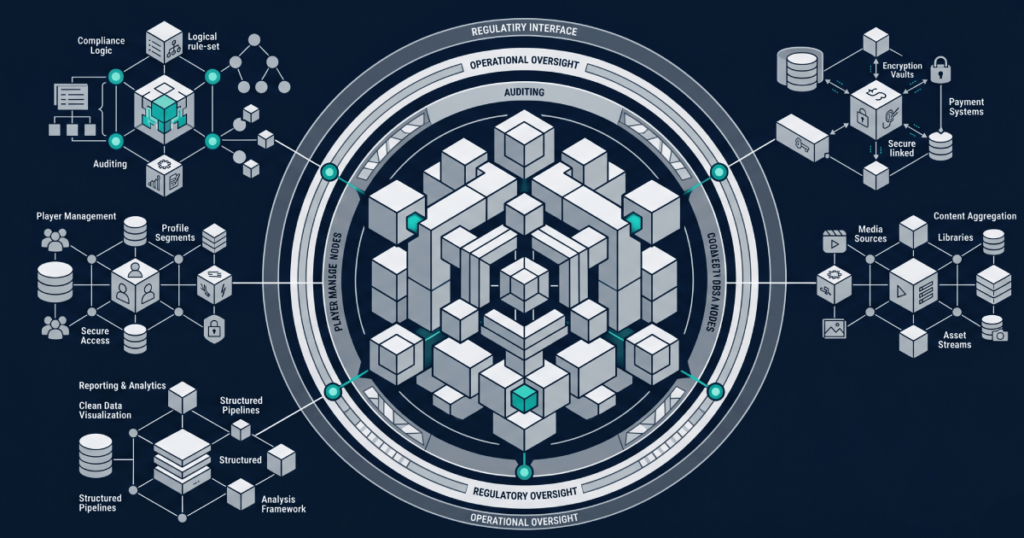
The Player Account Management (PAM) system is the nucleus. It handles registration, identity verification, session management, preference storage, and regulatory reporting hooks. A well-designed PAM is jurisdiction-aware: it knows that a UK player has different responsible gaming requirements than a Maltese player and enforces those constraints at the data model level, not through conditional logic bolted on after the fact.
The wallet service deserves specific attention because it’s the component most likely to constrain your future capabilities. A wallet that supports only synchronous, request-response transaction processing cannot support real-time fraud detection or streaming analytics. At Jadex Consulting, we consistently find that wallet architecture is the bottleneck operators hit when trying to implement AI-driven AML monitoring or real-time affordability checks. The wallet needs to emit events, support idempotent operations, handle multi-currency and multi-jurisdiction balances, and provide sub-second response times under peak load. Many legacy wallet implementations fail at least two of these requirements.
The sportsbook engine, if applicable, is typically the most latency-sensitive component. Odds compilation, bet acceptance, and settlement require tight integration with data feeds and risk management logic. Most operators consume sportsbook as a managed service rather than building in-house, but the integration point between the sportsbook and your PAM/wallet layer determines how much control you have over the player experience around bet placement and settlement.
Game aggregator integration is where product flexibility meets technical complexity. A game aggregator provides a single integration point to hundreds of game providers. But aggregation layers add latency, take a margin, and may limit your ability to negotiate direct commercial terms with high-performing studios. The architecture decision is: how many aggregators, whether to supplement with direct integrations for key providers, and how your content management layer handles game launches, tournaments, and jurisdiction-specific availability.
The Regulatory Gauntlet: Engineering for UKGC, MGA, and Beyond
Regulation is an engineering constraint, and it’s tightening faster than most platforms can absorb.
The UK Gambling Commission’s changing requirements around affordability checks, single customer view, and responsible gaming interactions demand specific architectural capabilities. You need the ability to aggregate player data across all touchpoints in near real-time, trigger configurable intervention workflows based on behavioural signals, and produce audit trails that satisfy regulatory inspection. This isn’t a compliance team problem. It’s a data engineering problem.
The Malta Gaming Authority requires specific technical standards around RNG certification, data integrity, and player fund segregation. The engineering implication is that your database architecture needs to support provably fair game outcomes, your financial systems need clear separation between operational funds and player balances, and your audit logging needs to be tamper-evident.
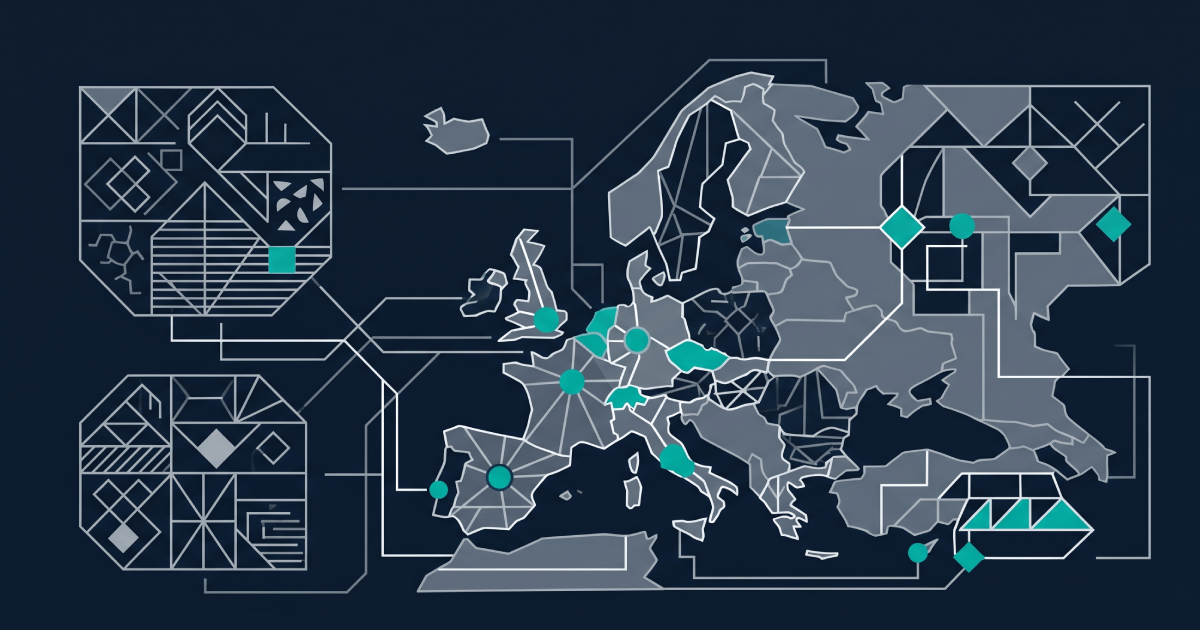
Multi-jurisdiction deployment compounds the challenge. Data residency requirements may mean you need jurisdiction-specific database instances. Responsible gaming rules differ. Marketing compliance rules differ. Tax reporting requirements differ. A monolithic backend that treats all jurisdictions identically will accumulate exception logic until it becomes unmaintainable.
The European Gaming and Betting Association (EGBA) plays a coordination role in advocating for regulatory harmonisation, but the practical reality for platform engineers is that each jurisdiction remains distinct. Your architecture needs to support jurisdiction as a first-class configuration dimension, not an afterthought.
We’ve worked with operators who discovered, mid-migration, that their platform couldn’t support the data segregation required for their target jurisdictions. That’s a discovery you want to make during architecture review, not during a licence application.
Modernization Pathways: Migrating from Legacy to Cloud-Native
If you’re running a legacy platform, you have three broad options. Each carries different risk profiles, cost structures, and timelines.
Full platform rebuild offers the cleanest architecture but the highest risk and longest timeline. You’re running two platforms in parallel until the new one is proven, then migrating players. The migration itself (player accounts, transaction histories, bonus balances, in-flight bets) is a project unto itself. We’ve seen rebuilds take 18 to 30 months for mid-size operators. Budget accordingly.
Strangler pattern migration is the approach we most frequently recommend at Jadex Consulting. You identify the highest-pain component of your legacy stack, typically the wallet or the front-end, and replace it first. An API facade sits between old and new, routing traffic progressively. Each phase delivers value independently while reducing the blast radius of any single change. It’s slower to complete than a big-bang rebuild, but you’re shipping improvements continuously and reducing risk at each step.
Component modernisation is the lightest touch. You keep the core platform but replace or augment specific systems: a new CRM, a modern bonus engine, a real-time analytics pipeline feeding off your existing database through change data capture. This works when the core is stable enough to build on but specific capabilities are blocking your roadmap.
The right path depends on the severity of your technical debt, your regulatory timeline pressures, and your team’s capacity for change. Any migration that runs while operations continue, and they all must, requires disciplined feature flagging, complete rollback planning, and a team that has done this before.
Selecting Your Engineering Partner: A CTO’s Due Diligence Checklist
Whether you’re evaluating an all-in-one provider, a niche specialist, or a custom development partner, these questions separate serious contenders from polished slide decks.
API documentation quality. Request access before signing anything. Is it versioned? Are the error codes specific and documented? Can your engineers build a proof-of-concept integration in a week? If the documentation is gated behind an NDA or “available after contract signing,” that tells you something.
Scalability evidence. Ask for load test results, not theoretical throughput numbers. What’s the P99 latency under peak load? How does the platform behave during a major sporting event or a popular game launch? What’s the auto-scaling policy, and what’s the cost model at 2x and 5x your projected peak?
Data ownership and exit strategy. What data formats are available for export? What’s the contractual mechanism for full data extraction at contract termination? Is historical player data included, or only active accounts? How long do they retain your data after termination?
Regulatory track record. How many UKGC, MGA, and GGC-licensed operators run on their platform today? Can they provide references from operators in your target jurisdictions? Have they undergone a regulatory audit, and what was the outcome?
Wallet architecture specifics. Does the wallet support event streaming? What’s the transaction processing model: synchronous, asynchronous, or hybrid? How does it handle multi-currency balances? What’s the reconciliation approach?
Team and process. Who will you actually be working with? What’s the escalation path for production issues? What’s their deployment frequency, and how do they handle breaking changes?
Total cost of ownership. Model this over three to five years. Include licence fees, revenue share, integration costs, ongoing support, the cost of your in-house team to manage the relationship, and the estimated cost of any required customisation. The cheapest option at year one is rarely the cheapest at year three.
At Jadex Consulting, we help operators work through exactly this kind of evaluation, including building the technical due diligence framework, assessing vendor claims against architectural reality, and defining migration strategies that reduce risk without stalling your commercial roadmap. The platform decision you make now will shape your competitive position for years. It deserves more than a vendor comparison spreadsheet.
About the Author: admin