
Casino Software Development: An Engineer’s Guide for Operators
The online gambling market is heading past $150 billion, in a global online gambling market that shows no signs of plateauing. UKGC’s tightening affordability checks, MGA’s evolving technical standards, and fragmenting compliance requirements across jurisdictions aren’t future problems. They’re hitting P&L lines now.
The question for operators isn’t whether to invest in platform architecture. It’s whether your current platform can absorb two more years of regulatory change without a rewrite. This is for the CTO sitting with a three-year platform decision.










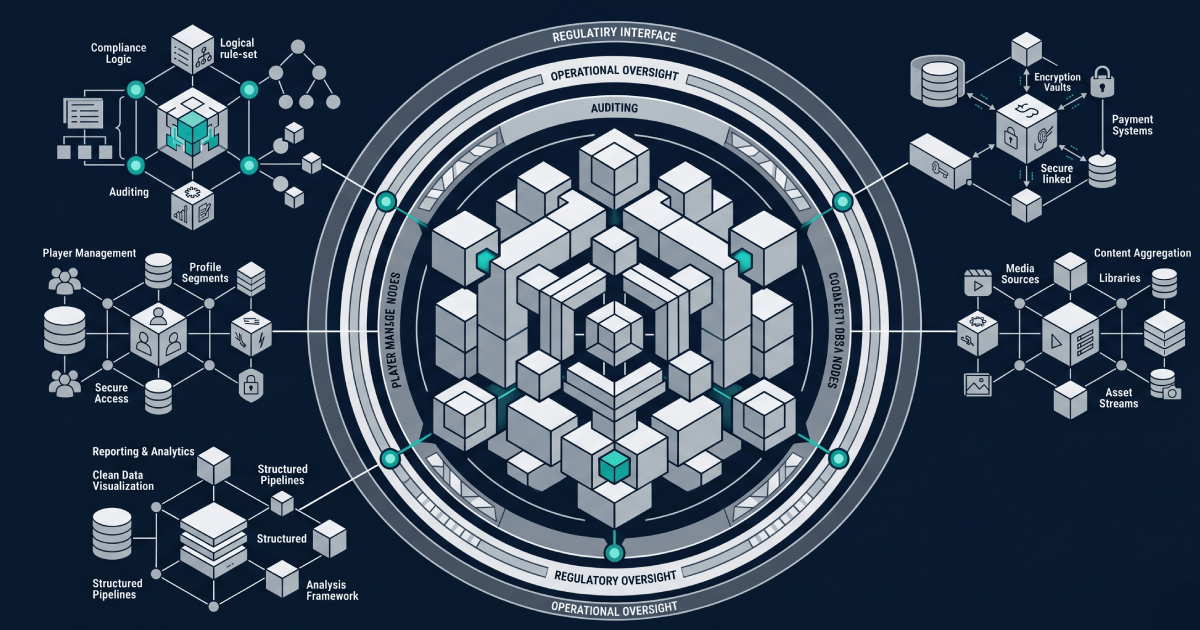
Compliance is an engineering discipline in regulated iGaming. It’s encoded in your data models, your API contracts, your event pipelines, and your deployment architecture. Treating it as a legal overlay on a finished platform is how operators end up with expensive retrofits.
UKGC’s technical standards require specific approaches to data storage, player interaction recording, and responsible gaming tool implementation. Your platform needs to enforce deposit limits, loss limits, session time limits, and reality checks as configurable, jurisdiction-aware services. These can’t be bolted on to a bonus engine as an afterthought. They need to intercept player activity at the transaction level. The responsible gambling technology stack required to meet these obligations has matured significantly — but only if it’s architecturally integrated, not retrofitted.
MGA’s technical standards overlap with UKGC requirements but diverge in specific areas. Data retention periods, reporting formats, and self-exclusion integration (with systems like GAMSTOP in the UK or equivalent schemes in Malta-licensed operations) have distinct technical implementations.
GGC (Gibraltar Gambling Commissioner) adds another layer, particularly around business continuity, disaster recovery, and the technical segregation of player funds.
The practical implication: if you’re operating across multiple jurisdictions, your platform needs a compliance configuration layer that can apply jurisdiction-specific rules without forking your codebase. Operators who hardcode UKGC rules into their core logic discover the cost when they expand to MGA or apply for a Gibraltar licence.
At Jadex Consulting, we’ve built compliance layers for operators like Rank Group that treat regulatory requirements as configurable policy, not embedded business logic. The difference in long-term maintenance cost is substantial.
Published cost ranges for casino platform development vary wildly, from $50,000 to several million dollars. These numbers are almost meaningless without context.
The variables that actually drive cost include: launch model (single jurisdiction vs. multi-market), number of payment integrations, game aggregator complexity, compliance feature depth, front-end sophistication, and whether you’re building on greenfield or migrating from an existing platform. Our detailed breakdown of the cost of building an online casino platform covers these variables in full.
But the biggest gap in most cost analyses is what happens after launch. Year-one hosting, monitoring, and operational costs for a production iGaming platform are substantial. You need 24/7 operational coverage, incident response capability, regular security patching, and ongoing compliance updates as regulatory requirements change. These costs don’t appear in a development proposal but they represent a significant portion of your three-year TCO. We model this in detail in our iGaming platform total cost of ownership analysis.
For operators evaluating build vs. buy, the honest comparison framework looks like this:
White-label TCO should include: revenue share (often 30-50% of GGR), change request costs for customisation, migration costs when you eventually outgrow the platform, and the opportunity cost of features you can’t ship because they’re not on the vendor’s roadmap.
Custom platform TCO should include: development cost (front-loaded), infrastructure and hosting, team augmentation or retained engineering support, compliance maintenance, and ongoing feature development. The crossover point — where custom becomes cheaper per month than white-label — typically falls somewhere in the 18-to-30 month range for operators generating meaningful GGR.
We encourage operators to model both scenarios over a five-year horizon with realistic revenue projections. The answer isn’t always custom. But for operators with ambitions beyond a single market, the economics usually favour ownership. If you’re at that decision point, our iGaming platform vendor due diligence framework gives you the right questions to pressure-test any vendor claim, and our iGaming platform vendor selection guide covers how to structure the final decision with internal stakeholders.
Results Are Designed, Not Hoped For
Clear Objectives. Tangible Outcomes.
Well engineered software is only part of the equation. True impact comes from aligning technology with commercial intent from the outset.
We define success early, measure consistently and refine continuously to ensure every product delivers meaningful and sustained value.

Future-Proofing Your Platform: AI, VR, and Architectural Choices
AI in iGaming is real, but the vendor hype around it is detached from the data infrastructure reality at most operators.
Meaningful AI applications in casino platforms fall into three categories: personalisation in iGaming (game recommendations, bonus targeting, session-aware content), fraud detection (behavioural anomaly detection, network analysis for multi-accounting), and responsible gaming (early identification of problem gambling patterns). The emerging capabilities in machine learning in casino platforms, from churn prediction to real-time risk scoring. are only accessible if the data infrastructure underneath them is clean. All three applications require the same prerequisite: a structured, real-time event stream from your platform services.
If your platform can’t emit structured events from your wallet, PAM, game session, and bonus services into a unified event pipeline, no AI vendor can deliver production-ready capability. The data infrastructure comes first. The models come second.
VR and AR gaming remain early-stage for most operators. The technology is maturing, but the player hardware adoption curve and the content creation costs mean these are two-to-three year horizon features rather than current priorities. An API-first architecture positions you to add immersive experiences when the market is ready, without rebuilding your core platform.
Blockchain has found specific applications in provably fair gaming and cryptocurrency payment support, but it hasn’t disrupted the core platform architecture in the way early evangelists predicted. If your target markets and player demographics warrant crypto payment support, it’s an integration concern, not an architectural one.
The broader point: the platforms that absorb new technology most efficiently are the ones built with clean service boundaries, well-documented APIs, and a data architecture that treats events as first-class citizens. Gamification in online gambling is a good example, the operators shipping meaningful loyalty mechanics and tournament features are the ones whose platform architecture made it a configuration exercise rather than a development project. Architectural choices you make today determine your ability to adopt whatever comes next.
Building Your Competitive Edge in a Regulated Market
Your platform is your product. In a market where game content is largely commoditised through shared aggregation layers, and where regulatory requirements create a rising floor of operational cost, the operators who win are the ones whose platform architecture gives them speed, flexibility, and compliance confidence.
Off-the-shelf solutions have a role for early-stage operators testing market viability. But for any operator with multi-jurisdiction ambitions, a growing player base, and commercial pressure to improve unit economics, the platform decision is a strategic one. Revenue share erodes margin. Vendor roadmap dependency slows time-to-market. Architectural constraints limit your ability to adopt AI, improve fraud detection, or respond to regulatory change without costly workarounds.
A custom platform, designed with clean service boundaries, jurisdiction-aware compliance configuration, and an event-driven data architecture, is the foundation that supports long-term competitive advantage. The upfront investment is real. So is the payoff.
We’ve built these platforms. We know where the complexity hides, what the real costs look like, and how to structure a migration that doesn’t put your operations at risk. If you’re evaluating your platform strategy this quarter, we’d rather have an honest conversation about trade-offs than hand you a brochure.
Latest from our blog
Insights & Perspectives
Our insights explore the intersection of technology, commercial strategy and disciplined execution across complex digital environments.


enquiry@jadexconsulting.com