
On This Page
AI in iGaming is generating more vendor noise than almost any other technology category right now, and that noise is making it difficult for operators to separate production-ready capability from well-packaged aspiration. This article maps the AI applications delivering measurable value today, the platform architecture prerequisites that determine whether any of it actually works, and the questions worth asking before committing budget to a vendor conversation.
AI in iGaming is not one thing
The first mistake operators make is treating AI as a single feature to procure. It isn't. AI in iGaming spans at least five distinct application areas: personalisation engines, fraud detection and AML monitoring, responsible gambling tooling, customer support automation, and odds or pricing optimisation. Each has a different maturity level, a different data requirement, and a different integration complexity. A vendor presenting "AI" without specifying which of these they mean is communicating very little.
If you're evaluating AI vendors, the starting point is mapping which applications are relevant to your platform model and player base. An operator focused on sports betting has different fraud exposure and personalisation levers than a slots-led casino operator. The use cases aren't interchangeable, and neither are the underlying models. Our work on iGaming platform engineering covers how these decisions translate into specific architecture choices.
Where AI is delivering measurable value today
Customer support automation
This is the most operationally mature AI application in iGaming right now. According to Symphony Solutions, iGaming operators deploying AI-powered support tools can autonomously manage approximately 70 to 80% of customer inquiries, reducing wait times while maintaining service quality. The cross-industry picture is similar: McKinsey reports that AI agents in contact centres have cut cost per call by up to 50% while increasing customer satisfaction scores, and Salesforce projects that 50% of service cases will be resolved by AI by 2027, up from roughly 30% in 2025.
These outcomes reflect what well-integrated support automation looks like when the underlying platform can feed the AI clean, structured interaction data. The commercial implication is straightforward: support is a cost centre that scales directly with player volume. AI support automation changes that relationship. It's the clearest near-term ROI case in the AI stack for most operators.
The caveat worth flagging: regulatory penalties for AML failures in customer-facing channels remain substantial. Crown Casino's $450 million AML fine in 2023 is a reminder that automated systems handling player interactions need to maintain compliance audit trails as a first-class concern, not a logging afterthought.
Personalisation engines
Personalisation is the second application where evidence of commercial impact is strong. Industry research consistently shows players value personalised offers and content, and the regulatory framing around personalisation is also tightening. Article 5 of the EU AI Act prohibits AI practices that exploit cognitive vulnerabilities, which has direct implications for how personalisation and retention models can be applied to gambling audiences. Personalisation systems used in gambling now need to be transparent, justified and auditable, not just commercially effective.
The technical challenge is that effective personalisation requires behavioural data at volume. A newly launched platform with limited player history won't get the same performance from a personalisation model as an established operator with 18 months of transaction and session data behind it. If you're building a new platform or recently launched, treat personalisation as a capability that matures with your player base. Not one that delivers full value at go-live.
Fraud detection and AML monitoring
Real-time pattern recognition outperforms rules-based systems at scale, particularly for operators in UKGC and MGA jurisdictions with strict AML obligations. The value here isn't just operational efficiency. It's compliance posture. A rules-based AML system flags what it was programmed to flag. A machine learning model identifies anomalies it was never explicitly told to look for, which matters when the threat vectors keep evolving.
Adoption is already widespread across the regulated financial sector. The UK's Financial Conduct Authority reports that 75% of firms are already using AI, with another 10% planning to adopt it within three years. Specialist AML vendors like Sumsub are explicit that legacy rules-based monitoring is increasingly inadequate against modern fraud tactics. The architectural implication for iGaming is that AML capability needs to live at the transaction layer with real-time event access. Not retrofitted as a reporting tool.
The platform architecture AI actually requires
Event-driven infrastructure is the prerequisite
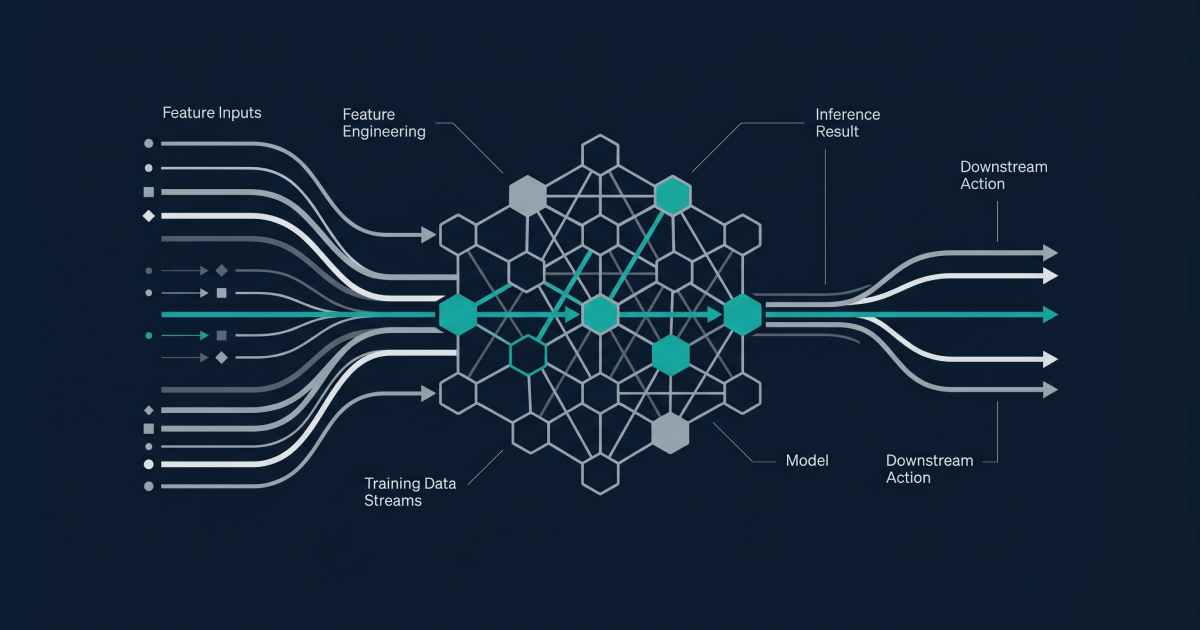
AI models are only as useful as the data infrastructure beneath them. Personalisation engines, fraud detection systems, and responsible gambling triggers all depend on low-latency access to player behaviour data as it happens. That requires an event-driven, API-first architecture where player actions generate clean, structured events that downstream systems can consume in real time. The architectural case for this is covered in our piece on the headless casino architecture trend.
Operators running monolithic or tightly coupled architectures will find AI integration expensive and brittle. The event data pipelines AI requires simply don't exist in legacy systems. Bolting an AI layer on top is possible, but the model will be working with stale, incomplete data, and the results will reflect that.
Wallet service design matters more than you think
A well-structured wallet service that emits clean transaction events is the foundation for both AML monitoring and personalisation. If your wallet service is processing transactions without emitting structured events, your fraud detection model has no signal to work with. This is a platform design problem before it's an AI problem, and it needs to be solved at the architecture layer, not patched at the integration layer.
For operators currently planning a new build, this is the argument for designing AI readiness in from day one. The event-driven data architecture AI requires isn't expensive to build correctly from scratch. It's expensive to retrofit into a platform that wasn't designed for it. The decision framework for that retrofit-versus-rebuild call sits in our iGaming platform modernisation guide.
Responsible gambling and the regulatory dimension
AI-driven monitoring under UKGC and MGA frameworks
AI-driven player behaviour monitoring is moving from optional to expected under UKGC and MGA responsible gambling frameworks. The UK Gambling Commission reports 37.4 million active online gambling accounts in the UK, representing a 24% increase over pre-lockdown levels. That scale makes manual oversight impossible, and the Commission now requires operators to use algorithmic monitoring tools that flag behavioural markers, including stake increases, loss chasing and session length anomalies.
If you operate or plan to operate in these jurisdictions, AI-driven monitoring isn't a future consideration. It's a current compliance requirement shaping platform design decisions now. GamStop integration adds another layer to this requirement. Real-time API connectivity, fail-safe enforcement and complete audit trails are platform-level engineering requirements, not feature requests. We cover the broader compliance picture in our breakdown of responsible gambling technology trends.
Automated interventions carry regulatory accountability
The dimension most vendor content skips: automated intervention systems don't just create product capability, they create compliance records. If an AI model flags a player as at-risk and no intervention follows, that creates an accountability problem. The regulator's question isn't whether you had the capability to identify the risk. It's whether you acted on it.
The architecture implication is that responsible gambling tooling can't be a separate system bolted onto the platform. It needs to be integrated at the data layer so AI signals can trigger real-time interventions through the same event infrastructure that drives other platform functions.
How to evaluate AI vendor claims without getting misled
Most AI vendor claims in iGaming are made at the model level: accuracy rates, prediction scores, benchmark results. What they don't address is integration complexity, data quality requirements, or latency constraints. A model that performs well on a benchmark dataset built from a high-volume tier-one operator's transaction history won't behave the same way on a newly launched platform with six months of sparse data. That gap is where vendor promises fall apart in practice.

The five questions in detail:
- Minimum viable data volume. What player history does the model require before it performs reliably? If the vendor can't answer this, they haven't thought about your context.
- Performance degradation with sparse data. Every model has a cold-start problem. Understand what yours will look like before you commit to an integration timeline.
- A demo on data that resembles your player base. Not benchmark data. Not their largest client's data. Yours, or something close to it.
- Integration architecture at the platform layer. API-first integration with clear event schemas is a good signal. Proprietary connectors that require platform modifications are a warning sign.
- Model governance and drift monitoring. Models degrade over time as player behaviour evolves. What's the process for detecting and correcting drift?
AI use cases to deprioritise for now
Generative AI for player-facing content and AI-driven game design are attracting significant vendor attention but remain early-stage in regulated iGaming contexts. The compliance review requirements for AI-generated content in regulated markets add friction that undermines the speed advantage these tools are supposed to provide.
Predictive churn models are widely marketed but frequently underperform on platforms without sufficient player history. If your platform has fewer than 12 months of behavioural data, treat churn prediction as a future capability, not a launch priority.
What this means for iGaming platform decisions in 2026
The gap between what's being marketed and what's production-ready at a mid-market operator level remains significant. The operators who will extract the most value from AI in iGaming aren't those who move fastest to implement it. They're the ones who build the platform architecture that makes AI integration reliable, compliant, and commercially measurable when the tooling matures.
For operators on legacy platforms, the sequencing question matters. Layering AI onto brittle architecture before addressing the underlying data infrastructure will produce unreliable results and erode confidence in AI as a capability. Treat AI readiness as a migration objective alongside performance and compliance. Not as a phase-two consideration that gets deferred until after the platform is stable.
The question for 2026 isn't whether to include AI in your platform. It's whether the platform you're building or migrating to will support AI at the data layer when you need it. The broader 2026 platform direction is covered in our iGaming industry trends 2026 analysis.
FAQ
Which AI applications in iGaming are production-ready right now?
Customer support automation, fraud detection, and AML monitoring are the most mature AI applications in iGaming today. Personalisation engines are production-ready for operators with sufficient player history. Generative AI for content and predictive churn modelling remain early-stage in regulated markets.
What platform architecture does AI integration require?
AI integration requires an API-first, event-driven architecture with real-time data pipelines. Monolithic or tightly coupled platforms lack the event infrastructure AI models depend on, making integration expensive and unreliable without significant architectural remediation.
How does AI help with responsible gambling compliance under UKGC and MGA?
AI enables automated detection of at-risk player behaviour patterns, deposit velocity anomalies, and session behaviour changes. Under UKGC and MGA frameworks, operators are expected to act on these signals in real time, making AI integration a compliance consideration as much as a product one.
What questions should I ask an AI vendor before committing budget?
Ask about minimum viable data volume, how performance degrades with sparse data, what the integration architecture looks like at the platform layer, and what model governance processes exist for detecting and correcting drift over time.
Should AI be built into a new iGaming platform from the start?
Yes. Designing AI readiness into a new platform build is significantly less expensive than retrofitting it later. The event-driven data architecture AI requires is straightforward to build correctly from scratch but costly to add to a platform that wasn't designed for it.
Next step
If you want to assess your platform's AI readiness, or map specific AI use cases against your current architecture and compliance requirements, speak to Jadex's iGaming engineering team. We work with operators across regulated markets to build the platform foundations that make AI integration reliable, compliant, and commercially measurable. See our full iGaming development capability.
About the Author: admin